Norse mythology fails to convey the sense of terror that must have hung over Asgard every time Loki was gone for longer than eight months and three weeks
Also you know that Loki regularly just…brings back random baby animals. That he found in the woods. Claims he gave birth to them. And people believe him every time.
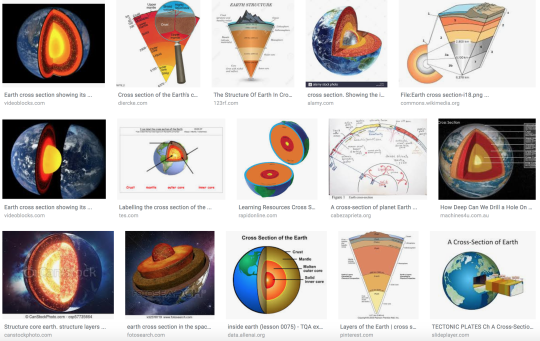
One of my favourite geology facts is this: These diagrams are a lie.
The mantle isn’t yellow. Nor is it orange, or red, or brown, or gray, or black.
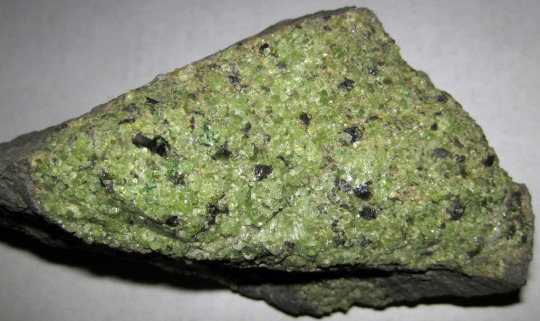
The earth’s mantle is made up largely of peridotite.
The earth’s mantle is lime green.
Here’s where it gets even more counterintuitive. It’s not molten!
Just going based on temperature, the mantle SHOULD by rights be molten. It’s hot enough to melt the rock. But because it’s so deep, there’s enough pressure to push it down into a solid!
Water is strange in that its solid form takes up more space than its liquid form. You know this, even if you don’t think you do – it’s why ice floats. This also means that when you put pressure on ice, it turns into water to try and become smaller. That’s why ice is slippery.
Pretty much every other material is the opposite of that – the solid form takes up less space than the liquid. So, even at a temperature where it should be a liquid, enough pressure can make it become as small as possible – and that requires it becoming a solid.
It still “wants” to melt, though. In areas where tectonic plates are moving apart, the mantle is exposed, which decreases the pressure on it dramatically. As it comes to the surface it actually cools slightly, but despite this, the drop in pressure is enough to make it turn into a liquid!
So, no, there isn’t magma under you (unless you happen to live on a volcano). There is liquid, though, but way deeper down – the outer core of the earth is made of liquid iron.
A long time ago I made the infinite glasses gif above. Then the other night I was trying to fall asleep and my brain kept telling me to do the same thing to confused white guy so… Here it is in 2 varieties!
Silver does this also, which was probably handy for silverware before antibacterial dish soap was invented.
That’s mentioned in the article as well. They also stated that a copper or silver container can disinfect a pot of water in a few hours. im gonna add a copper vessel to my emergency provisions now. @yourunclejingo you may find this stuff interesting too.
Its almost like our ancestors did shit that made sense even if they didn’t always fully understand why.
The thing that gets me about most arguments against accessibility features in video games is that they’re not just grossly ableist, they’re also hypocritical as hell. Video games have always had accessibility features: we just documented them poorly and called them “cheat codes”. Indeed, having a robust library of difficulty-modifying cheats was considered a mark in a game’s favour! The only difference is that a cheat code is theoretically a secret, which allows it to be framed as elite knowledge, even though it’s functionally identical to having an “infinite lives” switch on the options screen.
Here’s a thesis for you: the Konami Code was the first well-publicised accessibility feature.
being bad at video games is a disability now?
I’m going to assume you’re not being disingenuous here and take this as a serious question. In brief, very few people are generically “bad at video games”; in most cases, difficulty engaging with interactive media stems from one or more of a wide range of physiological conditions, including:
visual deficit (including colourbindness; colourblind individuals often have difficulty identifying threats in action games because they don’t stand out from the background for them)
repetitive strain injury in the hands, wrists or forearms (common for anyone who performs manual labour for a living)
arthritis and other degenerative joint conditions (both those due to age and those comorbid with many autoimmune disorders)
dyslexia (a common symptom of even mild dyslexia is the inadvertent mirroring of sensory-motor responses under pressure, e.g., moving your hand left when you meant to move it right – which is a big problem for action games!)
sensory processing disorders (delayed reaction to visual stimulus is a common symptom)
spatial processing disorders (see above)
chronic pain
propensity for motion sickness
This is, of course, only a partial list. Many of these issues are individually rare, but taken together, we’re looking a huge chunk of the population – up to 40%, by some estimates – who have at least one condition that would impact their ability to play the shooters and action-platformers that are held up as the gold standard for hardcore gaming.
hot tip: if your disability makes you bad at a thing, maybe either put in the extra effort to get good at it or just don’t do it instead of demanding people make the thing easier?????
Here’s the a better question: why is it an issue for you? Accessibility features in video games are entirely transparent to those who choose not to use them. Your experience of play isn’t affected by their existence in any way whatsoever unless you deliberately turn them on. Complaining about the mere existence of such features is like claiming that your viewing experience of a movie is being ruined by the fact that the disc has a subtitle feature on it, even though you haven’t actually turned subtitles on.
(And no, don’t try to frame this as video game developers somehow being victimised by unreasonable demands. The vast majority of developers are more than happy to include accessibility features in their games – and quite sensibly, because, you know, they’re businesspeople, and they want to sell things to as wide an audience as possible. The popular backlash against accessibility features is entirely on the player side.)
i just want to appreciate the genius in this thread who unironically typed what amounts to “if your disability makes you bad at a thing, try being good at the thing instead”
*try ti play a game and die multiple times cuz I enter in panic everytime I hear the intense music* I guess I have to get better at this ._.










 DarkestElemental616