
Pro-tip for Autistics
When I’m out and about and need to escape being overwhelmed with noise, light, or socializing, and the people I’m with don’t know I’m autistic, I don’t tell them that I’m heading towards a meltdown or am experiencing sensory overload.
I tell them I’m getting a migraine.
Meltdowns and migraines are, from my understanding, neurologically similar events, and for me they often go hand in hand– if I get one, it’s a signal to me that I’m likely to get the other pretty soon and need to take care of myself. The remedy is the same: removing myself from the situation and retreating to a dark, quiet room.
The difference is that NTs often don’t understand and simply dismiss sensory overload if you explain it to them as such, but nearly all of them understand what a migraine is and sympathize. 99% of the time, if I tell a NT that I have a migraine or am about to get one, they treat it as an emergency and help me get away from the source of the overload as quickly as possible. I am then free to recover in a quiet, dark place without anyone trying to invalidate my needs, forcing me to “tough it out”, or thinking that I’m rude for having to leave or to outright avoid certain events or situations in the first place.
Endorsed.
One of my partners gets seizures of the kind that disrupt sensory perceptions and cognition without being visible from the outside: we just call ‘em migraines sometimes for similar reasons.
If you do get actual migraines, it isn’t much of a stretch of the truth to say you’re getting one when you’re going to be getting one shortly.
But if you don’t, and you have a state of incapacity that requires roughly the same care? You totally have my permission as a bona fide migraine sufferer to just call it a damn migraine.
There is nothing wrong with providing a rough shorthand description to a stranger. You don’t owe any random person your full medical history, especially when you’re not in a state to be able to explain it!
… Oh. I thought migraines and overload were coincidentally overlapping. This explains a lot, actually.
Tag: autism
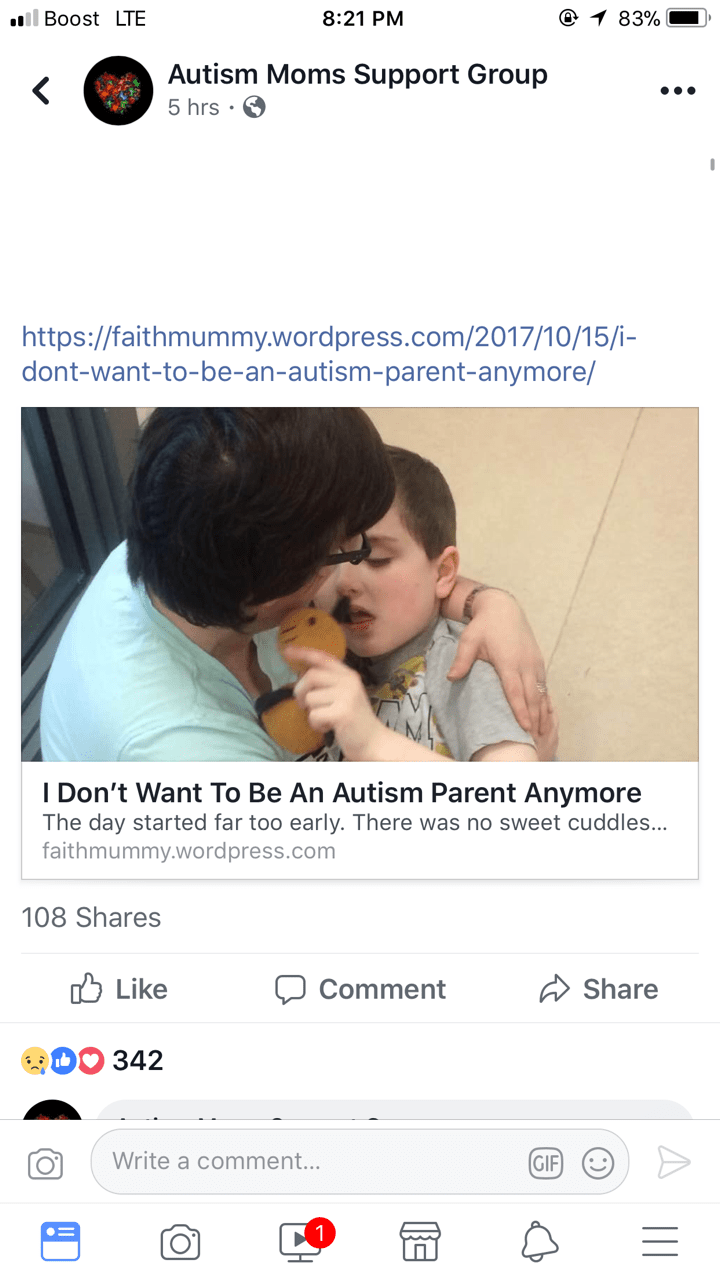
It’s this type of stuff right here that keeps me from being able to relate to parents of autistic children. The comments all say “I didn’t sign up for this.” Well you know what? You did. I did. The moment you conceived your child, you signed up for whatever that child would grow to be. You think it’s hard for YOU? Imagine how hard it is for THEM. You feel sorry for yourself because you “wake up to screaming every single day”? Feel sorry for the human being who wakes up screaming every day, because they’re crying for a reason. You don’t want to change your child or feed your child beyond toddlerhood? Then WHY did you become a parent? Why would you take the 1 in 68 chance, if you don’t want the chances of having an autistic child? If you resent your child this much, go fuck yourself.
If you treat your autistic relatives like this or treat other autistic people like this you’re an ableist monster, whether you have autism too or not.
“i didn’t want a child, i wanted a status symbol” pretty much sums the whole fucking “autism mom” attitude up imo
Can any other autistic people relate to this? When someone asks me an open-ended question about something I’m interested in and knowledgeable about, I don’t know how to infodump – it’s like all the information is there but I don’t know how to organize it or where to start, so I end up not being able to answer at all. Anyone else?
I ask for specifics. So if they ask something like “what do you know about 2A03?” I say “can you ask me specifically what you want me to tell you?” Cuz otherwise im sitting there with 1 million facts buzzing around and no way to know which one i should start with.
This is brilliant thank you for this post. This happened to me in a recent job interview and I was really stuck and it was awkward.
Yes, I just freeze and I can’t organise my thoughts into words. Thanks for the tip! 🙂
Honestly? The absolute worst part of autism would have to be that getting better looks like getting worse. Let me explain. There is no recovery with autism. It’s just part of you, that’s all. But neurotypicals and society at large force autistic people to try and fit in as much as possible. Don’t stim, don’t use echolalia, speak how we want you to, etc. etc. The way that you grow as an autistic person and avoid depression and anxiety and other negative side effects of autism is by giving those expectations the finger and being your true autistic self. But…this becomes a predicament. The people around you see you stimming more, speaking less, using echolalia more, whatever it may be, and they think you’re getting “worse.”
I’m gonna use myself as an example.
I’ve always appeared more neurotypical than many autistic people because that’s what I was forced to do growing up. I got really depressed and suicidal. I never let my autistic behaviors out and I got depressed. Holding in your autism, your true personality, will do that. Then, I started stimming more. Some stimming at school, a little stimming in public, lots of stimming by myself. I started to let myself avoid eye contact and be okay with that. I got less depressed. I got less suicidal. But, now I was visibly autistic, and therefore it looked to everyone else like my mental health must be getting worse. But it wasn’t. Those things that looked like me getting worse were actually me getting better and being myself.
The reason this is on my mind is that I’ve kind of reached a plateau in my recovery from the bad stuff in that now that I’ve had a taste of what being my true autistic self is like, I want it all. I’ve been stimming in front of people, but that’s starting to not be enough. I want to talk how I need to, I want to do my verbal stims, I want full body stims, not just my hands, but that’s another big step that’s gonna look like I’m getting worse and that, more than anything, is gonna get me a lot of judgement. Fidgety hands and mild bouncing aren’t tooooo weird or noticeable. Vocal stims, stomping, walking on the balls of my feet, being semi verbal, all that stuff…that’s what I need. That’s what I need to feel comfortable. But, the more autistic you appear, the “sicker” everybody thinks you are, when really, that’s what’s healthy for autistic people.
I guess what I’m getting at is that I just want to exist as my true autistic self without fear of judgement. More specifically, without causing people concern or even having people notice.
Perception of Shadows in Children with Autism Spectrum Disorders
I may have just learned why I struggled in art class so much.
The teacher tried really hard to help me learn how to add a congruent shadow to what I was drawing in an attempt to teach me how to make the item more realistic and identifiable as an object. But every time I added the shadow, the item no longer looked like what I was trying to show, but the teacher would say “see doesn’t this look better now?” And was confused when I said no.
According to this study, autistic people (children in the case of the study, but these things don’t change as you age) found it harder to identify objects if they had a congruent or incongruent shadow, but easily identified the item when shown without cast shadow (“floating in space” as art teachers would describe it). In contrast, control children who were neurotypical and had no history of anything else which could affect this kind of thing struggled to identify the object without the cast shadow, and as expected the one with the incongruent shadow.
It’s absolutely fascinating that finding out that I’m autistic has actually answered soooooo many questions I had about why I experience the world so differently.
And I guess it means that it’s ok for me to draw things without cast shadows if that’s what I am able to then enjoy looking at when finished. It also explains why I prefer colouring books to more traditional artistic pursuits because there is a clearly defined edge to the pictures and no expectation that you should be adding shadows outside of the lines.
Any other autistic people noticed this with themselves?
Oh this is absolutely fascinating… and explains a lot about what I struggle about art and trying to comprehend 3d form. Particularly notable was the idea that cast shadows and second order contrasts added noise, and interfered with and prevailed over processing an object.
This is honestly one of the big reasons I struggle with drawing from life actually, since I have to compete with the shadows in order to comprehend the form I am attempting to draw. Outside of just cast shadows, if you look at my art, you will see that I am only concerned with first-order (luminance-defined) shadows. And tbh, the way I draw them they don’t exactly behave like shadows, and only serve to define the object for me in a way that makes sense to me and nothing else. Even then, I try to keep them as simple as possible because anything more would be too much for what my brain can process. I would never touch the complex second-order (texture-defined) shadows because they actually keep me from recognizing an object. It is interesting stuff. The way they called it “noise” really does help me understand why it becomes so hard for me.
Also interesting is this is probably why I am unable to sleep without bright light directly around my head at least, because everything becomes unrecognizable otherwise and I become unable to identify even my own room.
Perception of Shadows in Children with Autism Spectrum Disorders
How to know if an organization for autism is bad:
- They use the puzzle piece
- They are or support Autism Speaks.
- They think that the percentage of the population that is diagnosed with autism is shocking.
- They think that more people are autistic now, and not that fewer autistic people are undiagnosed.
- They compare autism to diseases.
- A cure for autism is a major goal for them.
- They place a higher value on the opinions of those who know autistic people than on the opinions of autistic people.
- They believe that vaccines cause autism.
- Their leadership has no autistic people in it.
- They use person-first language.
- They compare autism to disease and disorders.
- Their idea of what autism is is entirely negative, even to the point of describing positives in a way that sounds negative.
- They call meltdowns “tantrums”.
- They encourage forms of child abuse such as applied behavior analysis.
- If you attend an event hosted by them, you are the only autistic person there.
- They only talk about children and imply that autistic adults don’t exist.
- They sympathize with parents who murder their children.
good things to keep in mind when looking for resources.
 DarkestElemental616