Would you like to know something interesting about falcons?
YES
Mid-century use of DDT and related pesticides caused a massive decline in wild raptor populations. They built up in the brids’ fatty tissues and caused their eggshells to become too thin, meaning many chicks did not hatch. Peregrine falcons became endangered in many parts of the world as a direct result.
Conservation efforts to save the species began in the late 1960′s, but there was one alarming problem: without parents of their own species to see, falcons raised by hand imprinted on humans. When these falcons reached sexual maturity, they had no interest in other falcons – they recognized their keepers as their mates and would not copulate with others of their own species.
So, falconers and conservation biologists did the logical thing: they developed special Falcon Sex Hats. They’re large rubber hats with a rolled brim, covered in a honeycomb of… orifices. The conservationist will wear this hat and then “court the male falcon by mimicking a female’s head bobs and vocalizations. If it works, the falcon will land on the hat and inject its genetic material into one of the honeycombs. It is then collected from the hat and used to artificially inseminate a female falcon.
It worked, and the peregrine falcon was removed from the Endangered Species list in 1999.
Here is a video of the hat in action:
Nowadays people mostly try to raise peregrine falcons using falcon puppets so that the chicks do not imprint upon human beings. Still, you can buy Falcon Sex Hats online, if you’re a falconer and wish to breed your birds that have eyes only for you.
i’ve gotten a few responses here asking for some clarification on this paper and why making essentially squishy plants was important enough to make it into the plant science section of nature, one of the most influential journals in the world, and i’d be happy to oblige and break this down a little!!
so to start off, plants have two kinds of membranes around their cells, while animals only have one. one of these is called the ‘plasma membrane’, which is a soft, squishy kind of membrane that we have as animals that just kind of holds everything in. the other kind that only plants have is called a ‘cell wall’, which in plant cells surrounds the plasma membrane to basically hold everything in even more, and is really rigid and hard instead of squishy. the cell wall is made of a strong substance called ‘cellulose’, which you prob have heard of before, which acts as a really strong support structure to hold up the plant and protect the cells. the cell wall has a lot of different functions, but one of the main ones is structural; the pressure between the cell wall and the water inside the plant’s plasma membrane forming ‘turgor pressure’, which keeps the plant upright (when a plant needs water, it’s turgor pressure goes down, and there isn’t enough water in the cells to push against the cell wall to hold it upright. this is what causes wilting!)
now here’s the problem with cellulose: it’s a BITCH to break down. in settings where people are trying to make biofuels and renewable oils from algae and plant materials (and being successful in limited amounts!!), cellulose is the biggest thing keeping the process from higher efficiency, making it harder for those techniques to keep up with fossil fuels. but removing the cell wall altogether wacks out the plant’s turgor pressure, upon which a TON of natural processes and biological functions in plants are based (turns out that maintaining water pressure is really important when you dont have like, blood to keep stuff going!! or a heart to move shit around!!). so we need some kind of hard thing for the plant cells to push against to keep up hydraulic pressure, but it cellulose is too hard for efficient use in sustainable fuels.
which brings us to this study. im sure u can tell where this is going now. basically, these researchers were like, ‘what if we just added a second plasma membrane?? so its like, thicker, but there’s no cellulose???’.
this worked well. like, really well. i have made an annotated version of some of their results:
so in conclusion: this is a really cool paper, and not only did it show that it could be done, but they actually identified a ton of genes and transcription factors that could be modified to make replacement of a plant cell wall possible by other people.
this is a huge generalization, of course- they have way more data in the paper here if y’all wanna see it for themselves– but overall??? this technology could be really big in increasing the viability and efficiency in biofuels and sustainable biochemicals to be used in stuff like cosmetics, fabrics, plastics, etc.
hey i almost forgot, i used the herbarium’s photography setup to take Super High Res Images of those really cool bisected Stylites specimens! i still need to process the images to a more accessible format (theyre photoshop files right now) but it’s crazy, you can see the primitive vascular trace up the middle and what looks like a couple similarly primitive different woody tissues. i need to read up more on isoetale anatomy to be able to tell whats what, but its pretty goddamn cool just seeing the inside a bit closer.
these are lower quality bc theyre screenshots but this is prob my fave image. look at the weird little pore structures right below the leaves- i can’t tell if those are like, sieve tubes or xylem bc the corm/rhizome woody thing is technically a modified stem and the pores taper off into the line down the center of the plant that i’m assuming is the main vascular trace so like maybe, but like at the same time these plants literally evolved before roots were a thing (those ‘roots’ that u see are not roots, but in fact modified leaves bc they never learned how to make modern roots with root hairs and specialized root tissues, thats how fucking old they are) so like can we even compare the anatomy of this to a modern plant in any capacity? what is even happening here? what the hell is this? i love it
In the Twilight universe, “vegetarian” vampires have golden eyes from drinking animal blood, a more ethical source than human blood, which would give them red eyes. It has also been established that a diet of human blood makes vampires physically stronger. So, if the Cullens wanted to become stronger without jeopardizing their morals, could they consume mosquitoes instead? How many mosquitoes would they have to eat to survive? Since mosquitoes drink from both humans and animals, what color would their eyes be? Orange? In this essay, I will
on average an adult has about 4.5-5.5 liters of blood circulating in their body. a female mosquito, when completely full, can hold up to 0.001-0.01 milliliters of blood in their abdomen depending on the species. if we take the average of both (5 liters & 0.0055 milliliters), it would take around 909,090 mosquitos to equal the amount of blood in a single human. although there isnt an exact number of the entirety of the mosquito population, we can use fermi estimation. there is about 57 million square miles of total land area on earth, while say 50 million square miles are habitable for mosquitos. with a rough of estimate of 1 mosquito per 50 square feet (overestimate due to area and time of year). after multiplying the numbers and fixing the units, there is a rough estimated 70 quadrillion mosquitos. theoretically, if a vampire lived in a mosquito dense area, such as brazil, indonesia, malaysia, thailand, etc, and could sustainably hunt around a million mosquitos to fill themselves every time they needed to feed, there would be enough mosquitos to survive on due to their large population and fast reproduction.
This is honestly everything I have ever wanted thank you for your contribution to the cause
Hey guys I think I figured out why vampires can turn into bats
dwarfs evolved in deep subterranean societies, and it shows. their eyesight is shit; their skin is intensely sensitive to the sun. the first human diplomats to come in contact with them mistakenly labeled the dwarfs a war-like people because they were so seldom seen without layers of protective clothing; it was a while before anyone realized that dwarven skin just burns easily and needs to be kept safe under layers.
due to their tendency to stay covered up when aboveground, it was longer much longer before anyone found out that dwarfs also glow.
they’ve since developed much fancier ways of keeping track of each other down in the tunnels, of course, but there’s this fun little holdover, stripes of faint blue or green (think of the way veins look on pale humans) swirling over their entire bodies, each dwarf boasting a pattern that’s entirely unique.
topside they look like nothing more than interesting or possibly puzzling tattoos – why did you need that stripe crossing right over your eye like that? – but get them down in a cavern, let them shed their protective suits, and marvel. they live and work down in the deepest levels, where humans can’t see their own hands in front of themselves but can sure as hell see the familiar lines of their dwarf buddies, shining to show them the way.
or, okay, if we do want to get into fighty dwarfs
nighttime is fine; as soon as the sun goes down they’re free to remove their heavy protective suits (dwarfs going sleeveless to let their skin glow)
and, thus unencumbered, surround their enemies’ little campsite
and the last thing anyone sees before everything goes to hell are ghostly blue and green swirls floating through the night
jesus crust makenzie this is horrifying and i love it
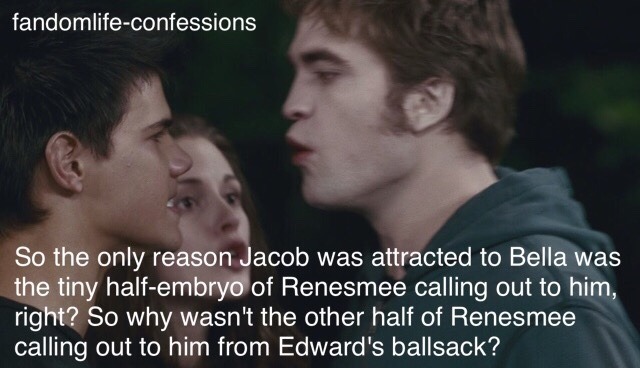
Everyone in the comments talking about how a woman is born with all her eggs and has them her whole life but a sperm cell is only made maybe a couple of days before conception and now all I can think of is that one really weird week, right before Edward and Bella get married, where Jacob is freaking out because he finds Edward smoking hot out of nowhere and that’s why he was being weird at the wedding.
TECHNICALLY EDWARD ISN’T EVEN SUPPOSED TO BE PRODUCING NEW SPERM
God: Okay, here’s the Earth, have fun in the trees.
Some monkey like six million years ago: Hey guys check out this bipedalism mod.
God: Oh, I guess you guys can keep looking for berries and stuff on the ground now.
Some pre-human smashing two rocks together: Listen up everybody, I have the cheat codes for a new item to access more food for your inventory.
God: Oh, you guys sure are doing a lot. Too bad there’s not a way to organize yourselves.
Some hominin guy: Install hyoid_morphology.exe and you can access chat from within the game.
God: But don’t you have to watch out for those bigger animals I put down there?
Some early human, looking at a mammoth: bro, you can win the boss battle if you just combine your wood-type weapon with your stone-type weapon and avoid a critical hit.
God: Okay you guys, you’re breeding pretty fast, and the Earth can only provide for about 10m of you, so save space!
Some Neolithic Dude: Lmao Earth HACKED – guys just empty your inventory of a bunch of plants right by your spawn point and then you have to use way less energy to collect the items.
Everybody and their cousin has experienced the argument “is a tomato a fruit or a vegetable” at some point in their lives. It’s a fun bit of trivia, and let’s know-it-all’s speak condescendingly, or at least they did like 10 years ago. “Knowledge is knowing tomato is a fruit, wisdom is not putting it in a fruit salad”. Whatever.
Which brings up the point, that botany and culinary sciences are very different. Botany is the study of plants, culinary is cooking and how things taste. Botany is science, and it has rules (kind of), where cuisine is full of guidelines that are completely cultural.
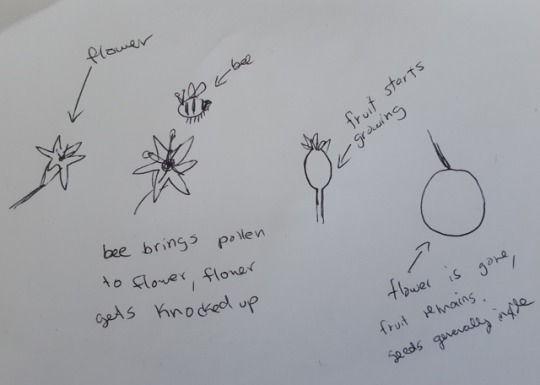
Tomatoes are a fruit. A fruit is how many plants have babies, and are made in the ovary of a flower. I have a diagram.
Armed with this knowledge we can know that tomatoes, cucumbers, squash, beans, peas and peppers are all fruit.
“Now”, I ask you, “what are lettuce, and cabbage, and spinach, and kale”?
“Vegetables”, you say, assuredly.
“Yes, but, what are they?”
“…vegetables”, you say, slower, and louder this time, not quite sure what I’m wanting from you.
No. They are leaves.
What are carrots, beets and radishes? Roots. What about celery and rhubarb? Stems. Potatoes? Tubers (food storage for the plant, and where new plant babies will grow from). Garlic and onions? Bulbs (also food storage). Mushrooms? They’re not even a plant, they’re a fungus, in the kingdom of fungi, which is somewhere between the plant and animal kingdoms.
“Vegetables” is just a word for plants that we eat, that doesn’t have enough sugar to be a fruit, and not enough flavour to be a herb or spice.
Botanically speaking, there is no such thing as a vegetable. They’re just different parts of a plant that happen to be edible.
There are other plants, normally considered weeds, that can be “eaten like a vegetable”. Dandelion, stinging nettle, dock, purslane, can all be cooked and eaten, making them vegetables, at least to the people to treat them as such. It’s all very cultural, and biased, and based on nothing but what people think it is. Therefore, they are not a real thing, it’s just a concept.
Type of weed that causes series allergies for a lot of people. Also related to chamomile.
Fun fact: ragweed pollen has remained vitually unchanged since the last Ice Age and expiriments are underway in Denver to see if:
1. Ancient Ragweed Pollen is viable with Modern Ragweed Flowers (All signs currently point to yes)
2. If the resulting Hybrid Ragweed is less allergenic than Modern Ragweed (signs point to maybe- people working with ancient pollens so far have had either NO reactions when expected, or unexpected and severe reactions)
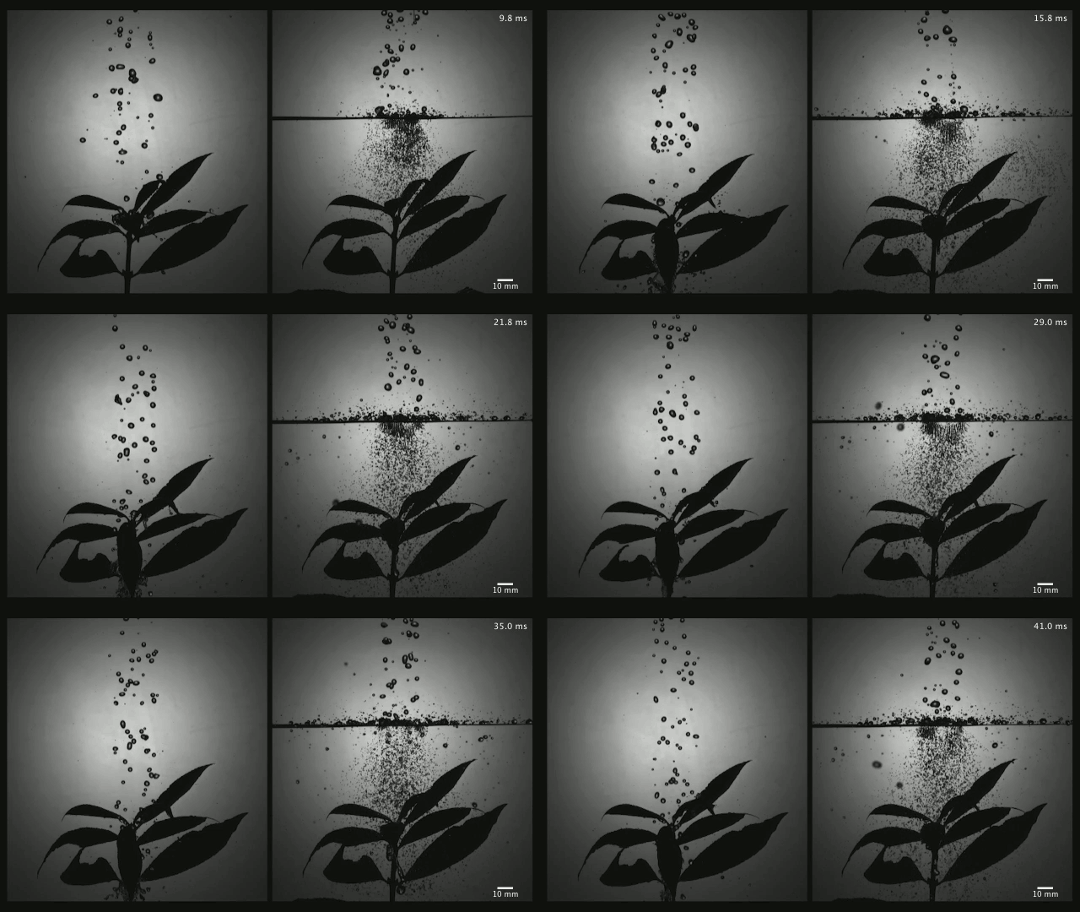
Lots of applications – from rocket engines to ink jet printing – require breaking large droplets into smaller ones, so there are many methods to do this. Some techniques rely on fluid instabilities, others use ultrasonic vibration. But one of the most effective methods may also be the simplest: placing a mesh between large drops and their target.
That’s the idea at the heart of this new study, which uses a wire mesh to break large droplets into a spray of finer ones 1000 times smaller. The target application is agricultural spraying, and the researchers argue that their method would allow farmers to treat their crops effectively with fewer chemicals and less run-off. Drops impacting the mesh form a narrow cone over the plant, and the smaller, slower droplets are better at sticking to the plant instead of bouncing away. They’re also less likely to injure crops, since they don’t disturb the leaves the way larger drops do. (Image and research credit: D. Soto et al.; via MIT News; submitted by Omar M.)


 DarkestElemental616