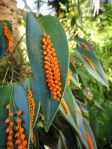
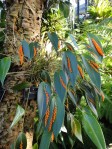
These rebellious young whipper-snapper-damn-“Millenials” are most definitely orchids. Don’t worry though, even though their racemes make them look like a back-talking pierced-tongue millenials, they aren’t capable of destroying any of our hard-won industries, primarily because they are “orchids” according to what Rush Limbaugh and Tomi Lahren said this morning, and are not, infact, millennials.
I however am still skeptical. Just look at them! With so many tongue piercings, I can’t fathom how they could be anything BUT millennials. They could be the very death of our Fabric Softener Industry. Just think of how the Diamond-encrusted Gold Watch Industry would suffer if all of the piercings are on their tongues! These millennials just obviously don’t know how to spend their money properly.
(Not my images, darlings. For these and other lovely orchids, check out Ruben Senes’s Flikr, here )
P.S. These are not actually images of millennials. Please note that these are plants and therefore have no money to spend improperly.
i’ve gotten a few responses here asking for some clarification on this paper and why making essentially squishy plants was important enough to make it into the plant science section of nature, one of the most influential journals in the world, and i’d be happy to oblige and break this down a little!!
so to start off, plants have two kinds of membranes around their cells, while animals only have one. one of these is called the ‘plasma membrane’, which is a soft, squishy kind of membrane that we have as animals that just kind of holds everything in. the other kind that only plants have is called a ‘cell wall’, which in plant cells surrounds the plasma membrane to basically hold everything in even more, and is really rigid and hard instead of squishy. the cell wall is made of a strong substance called ‘cellulose’, which you prob have heard of before, which acts as a really strong support structure to hold up the plant and protect the cells. the cell wall has a lot of different functions, but one of the main ones is structural; the pressure between the cell wall and the water inside the plant’s plasma membrane forming ‘turgor pressure’, which keeps the plant upright (when a plant needs water, it’s turgor pressure goes down, and there isn’t enough water in the cells to push against the cell wall to hold it upright. this is what causes wilting!)
now here’s the problem with cellulose: it’s a BITCH to break down. in settings where people are trying to make biofuels and renewable oils from algae and plant materials (and being successful in limited amounts!!), cellulose is the biggest thing keeping the process from higher efficiency, making it harder for those techniques to keep up with fossil fuels. but removing the cell wall altogether wacks out the plant’s turgor pressure, upon which a TON of natural processes and biological functions in plants are based (turns out that maintaining water pressure is really important when you dont have like, blood to keep stuff going!! or a heart to move shit around!!). so we need some kind of hard thing for the plant cells to push against to keep up hydraulic pressure, but it cellulose is too hard for efficient use in sustainable fuels.
which brings us to this study. im sure u can tell where this is going now. basically, these researchers were like, ‘what if we just added a second plasma membrane?? so its like, thicker, but there’s no cellulose???’.
this worked well. like, really well. i have made an annotated version of some of their results:
so in conclusion: this is a really cool paper, and not only did it show that it could be done, but they actually identified a ton of genes and transcription factors that could be modified to make replacement of a plant cell wall possible by other people.
this is a huge generalization, of course- they have way more data in the paper here if y’all wanna see it for themselves– but overall??? this technology could be really big in increasing the viability and efficiency in biofuels and sustainable biochemicals to be used in stuff like cosmetics, fabrics, plastics, etc.
hey i almost forgot, i used the herbarium’s photography setup to take Super High Res Images of those really cool bisected Stylites specimens! i still need to process the images to a more accessible format (theyre photoshop files right now) but it’s crazy, you can see the primitive vascular trace up the middle and what looks like a couple similarly primitive different woody tissues. i need to read up more on isoetale anatomy to be able to tell whats what, but its pretty goddamn cool just seeing the inside a bit closer.
these are lower quality bc theyre screenshots but this is prob my fave image. look at the weird little pore structures right below the leaves- i can’t tell if those are like, sieve tubes or xylem bc the corm/rhizome woody thing is technically a modified stem and the pores taper off into the line down the center of the plant that i’m assuming is the main vascular trace so like maybe, but like at the same time these plants literally evolved before roots were a thing (those ‘roots’ that u see are not roots, but in fact modified leaves bc they never learned how to make modern roots with root hairs and specialized root tissues, thats how fucking old they are) so like can we even compare the anatomy of this to a modern plant in any capacity? what is even happening here? what the hell is this? i love it
the botanical society of america’s new database of botany education tools. unfortunately, most of what i’m seeing is still geared towards younger middle/high school students, but there are still some good resources in there if you look. my quest to find easily accessible botany things for teens and adults just wanting to learn and have a good time continues
Everybody and their cousin has experienced the argument “is a tomato a fruit or a vegetable” at some point in their lives. It’s a fun bit of trivia, and let’s know-it-all’s speak condescendingly, or at least they did like 10 years ago. “Knowledge is knowing tomato is a fruit, wisdom is not putting it in a fruit salad”. Whatever.
Which brings up the point, that botany and culinary sciences are very different. Botany is the study of plants, culinary is cooking and how things taste. Botany is science, and it has rules (kind of), where cuisine is full of guidelines that are completely cultural.
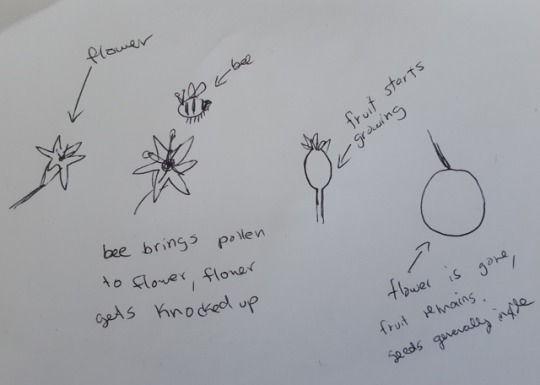
Tomatoes are a fruit. A fruit is how many plants have babies, and are made in the ovary of a flower. I have a diagram.
Armed with this knowledge we can know that tomatoes, cucumbers, squash, beans, peas and peppers are all fruit.
“Now”, I ask you, “what are lettuce, and cabbage, and spinach, and kale”?
“Vegetables”, you say, assuredly.
“Yes, but, what are they?”
“…vegetables”, you say, slower, and louder this time, not quite sure what I’m wanting from you.
No. They are leaves.
What are carrots, beets and radishes? Roots. What about celery and rhubarb? Stems. Potatoes? Tubers (food storage for the plant, and where new plant babies will grow from). Garlic and onions? Bulbs (also food storage). Mushrooms? They’re not even a plant, they’re a fungus, in the kingdom of fungi, which is somewhere between the plant and animal kingdoms.
“Vegetables” is just a word for plants that we eat, that doesn’t have enough sugar to be a fruit, and not enough flavour to be a herb or spice.
Botanically speaking, there is no such thing as a vegetable. They’re just different parts of a plant that happen to be edible.
There are other plants, normally considered weeds, that can be “eaten like a vegetable”. Dandelion, stinging nettle, dock, purslane, can all be cooked and eaten, making them vegetables, at least to the people to treat them as such. It’s all very cultural, and biased, and based on nothing but what people think it is. Therefore, they are not a real thing, it’s just a concept.
Type of weed that causes series allergies for a lot of people. Also related to chamomile.
Fun fact: ragweed pollen has remained vitually unchanged since the last Ice Age and expiriments are underway in Denver to see if:
1. Ancient Ragweed Pollen is viable with Modern Ragweed Flowers (All signs currently point to yes)
2. If the resulting Hybrid Ragweed is less allergenic than Modern Ragweed (signs point to maybe- people working with ancient pollens so far have had either NO reactions when expected, or unexpected and severe reactions)
Ever gotten stung by a bee? Bitten by a spider that had some pain juice in its bitey parts? Brushed against some stinging nettle? Had a mosquito suck your lifejuice from your body and leave a present behind?
This is your time. Yes, indeed. In this post, I shall empower you to pick a leaf off the ground…. and chew it up. And spit it back out. Onto yourself.
[Disclaimer: if you get bitten by something real bad, do not pick a leaf off the ground. Pick up a phone. Call an ambulance. Go to the doctor.]
Have you ever seen
THIS WEED?
It grows in many places. It is your friend. It wants to help you. Sometimes it is big, sometimes it is small. It is called
Broadleaf Plantain
Broadleaf Plantain is edible, click the link if you don’t believe me, do your own research, it is 100% non toxic. Although it tastes real bad. Don’t eat it, unless you want to, I guess.
Grows all over. Which is good. Now getting to the spitting-on-yourself part.
Broadleaf Plantain
has healing properties! According to Wikipedia which is not a reliable source according to all my teachers, the active chemical constituents are aucubin (an anti-microbial agent), allantoin (which stimulates cellular growth and tissue regeneration), and mucilage (which reduces pain and discomfort).
I just plagiarized. Sorry Mr. Stearns.
Okay so on the not-wikipedia front, this has helped me with
a spider bite
a bee sting
a burn
blisters
stinging nettle
mosquito bites
The bee sting was today, on the bottom of my foot, and I used it and bam was walking (with only a tad bit of discomfort) within 10 minutes. 5-10 but I don’t want false advertisement
Mosquito bites? I was hanging with some family in the mountains and the mosquitoes were EVERYWHERE and everyone was getting bitten. And I was like, I know a plant
But! I wasn’t sure if it grew around there. So I looked, made no promises, found a bunch of scrawny lil buggers growing in the gravel. “you don’t need your leaves,” I said, and stole them.
Okay so. So. spitting on yourself. Let’s get there. Do you know what a poultice is? No? Okay here’s what:
it’s mushed up plants that serves a purpose. The purpose of plantain, as I said earlier, is to stop those damn bug bites from being so itchy and/or painful.
There are two ways to make a poultice: get get leaf, put on rock, add a bit of water, and mash into tiny tiny mush, or the more convenient version:
CHEW IT UP! STICK THAT MOFO IN YOUR MOUTH AND CHEW! YOU NEED NO WATER, YOU HAVE SALIVA! YOU NEED NO ROCKS, YOU HAVE MOLARS!
Then once it’s nice and ground up get that plant out of your mouth and slap it on the bug bite. It should be pretty moist (the juices are what help so much) but not so much that it’s going to drip off you. It should kinda stick. Use another leaf, or tape or something to keep it there if need be.
Does it look kinda like this? Great! Ya done did it!
With those mosquito bites I mentioned, it reduced swelling the size of a quarter in about 20 minutes! The guests loved it! You get real popular because you saved them from pain! I used the “styrofoam plate, knife, add water, try your best” method for them because saliva was a big no no and everyone wanted it real hygienic. Don’t fool yourself. Saliva itself has slight antimicrobial properties so it’s for the best, anyway.
Haven’t seen that plant? Well have you seen
Narrowleaf Plantain?
Narrowleaf Plantain has the same properties and it looks like this:
Young man, there’s no need to feel down
I said young man, chew a leaf off the ground
The next time you get bitten by one of mother nature’s beautiful creatures, I hope you feel empowered to pick a leaf off the ground and spit it back onto yourself.
This has been a public service announcement
I have been taught since I was small that dock leaves were for nettles, I wonder if that was a miscommunication?
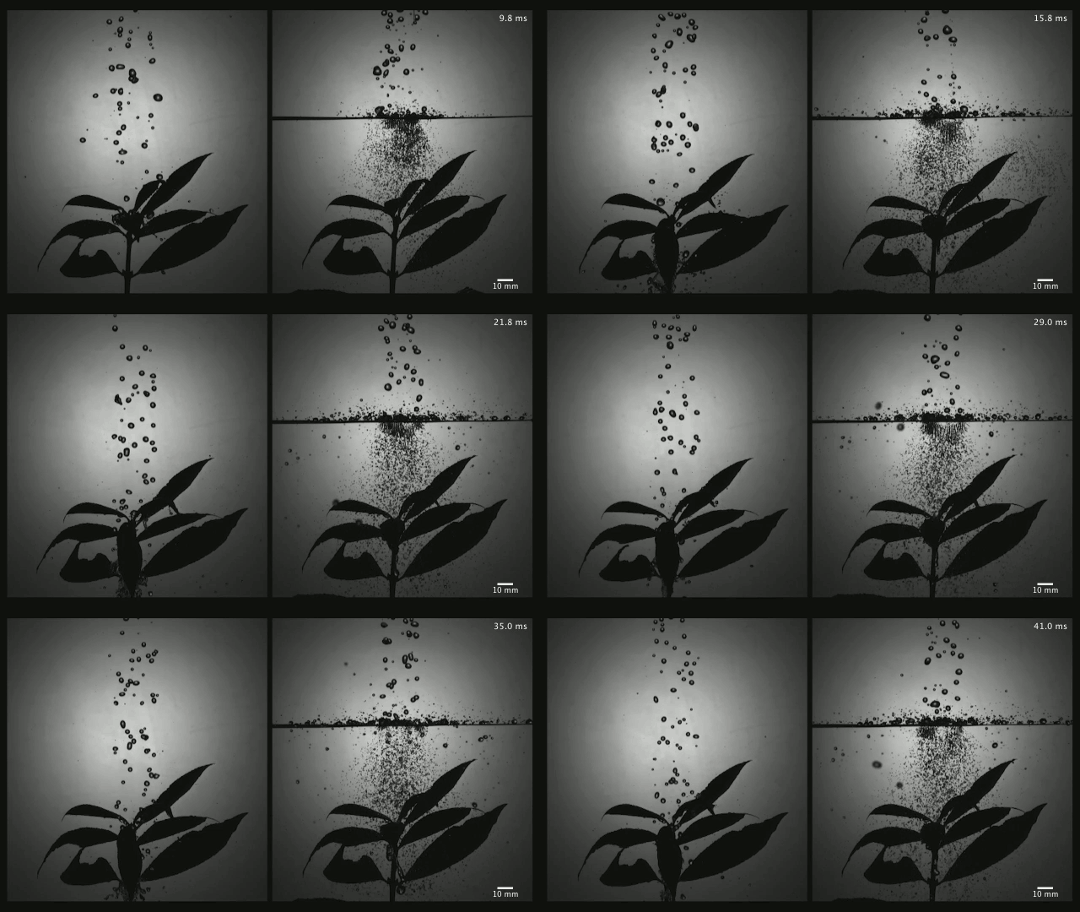
Lots of applications – from rocket engines to ink jet printing – require breaking large droplets into smaller ones, so there are many methods to do this. Some techniques rely on fluid instabilities, others use ultrasonic vibration. But one of the most effective methods may also be the simplest: placing a mesh between large drops and their target.
That’s the idea at the heart of this new study, which uses a wire mesh to break large droplets into a spray of finer ones 1000 times smaller. The target application is agricultural spraying, and the researchers argue that their method would allow farmers to treat their crops effectively with fewer chemicals and less run-off. Drops impacting the mesh form a narrow cone over the plant, and the smaller, slower droplets are better at sticking to the plant instead of bouncing away. They’re also less likely to injure crops, since they don’t disturb the leaves the way larger drops do. (Image and research credit: D. Soto et al.; via MIT News; submitted by Omar M.)
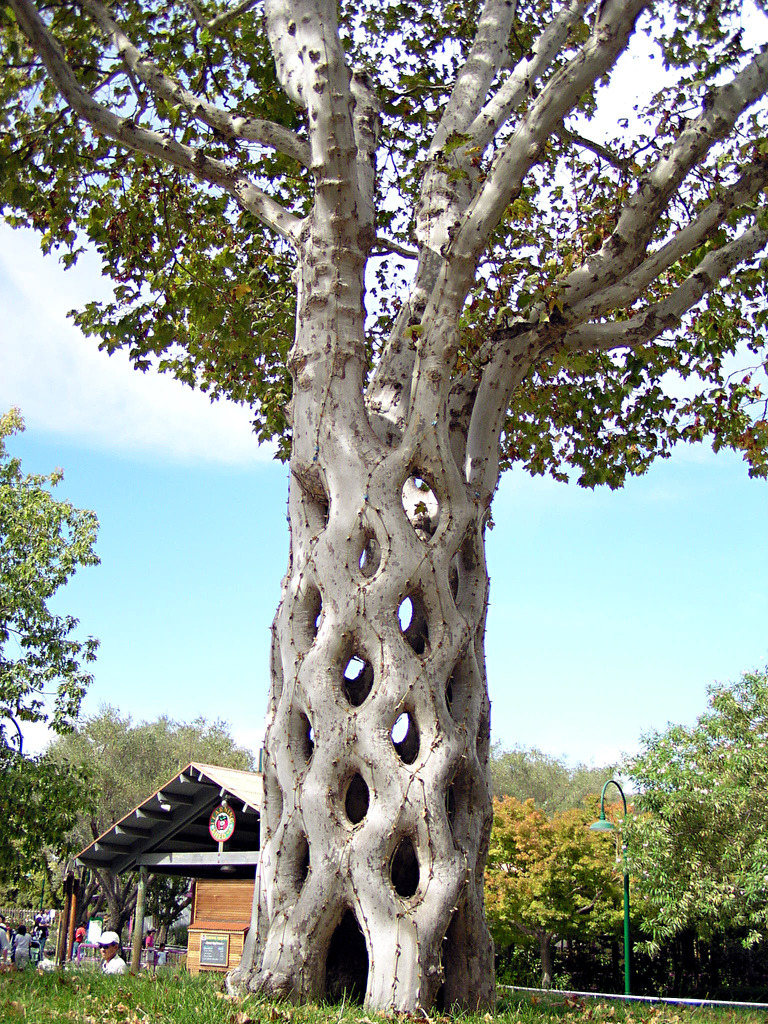
Circus Tree: Six individual sycamore trees were shaped, bent, and braided to form this.
Actually pretty easy. Trees don’t reject tissue from other trees in the same family. You bend the tree to another tree when it is a sapling, scrape off the bark on both trees where they touch, add some damp sphagnum moss around them to keep everything slightly moist and bind them together. Then wait a few years- The trees will have grown together.
You can use a similar technique to graft a lemon branch or a lime branch or even both- onto an orange tree and have one tree that has all three fruits.
Frankentrees.
As a biologist I can clearly state that plants are fucking weird and you should probably be slightly afraid of them.
On that note! At the university (UBC) located in town, the Agriculture students were told by their teacher that a tree flipped upside down would die. So they took an excavator and flipped the tree upside down. And it’s still growing. But the branches are now the roots, and the roots are now these super gnarly looking branches. Be afraid.
But Vi, how can you mention that and NOT post a picture? D:
I am both amazed and horrified of nature as we all should be
I love how trees are like “fuck it, I’ll deal” at literally everything. Forest fire? Cool, my seeds’ll finally grow. Upside down? Branches, suck, roots, leave. What’s this new branch? Eh, welcome to the tree buddy.
I need to be more like tree
I continue to fear and respect out arboreal overlords.
what kind of professor did these students have that they needed to prove him wrong so badly that they literally dug up a tree, flipped it and put it back in the ground?
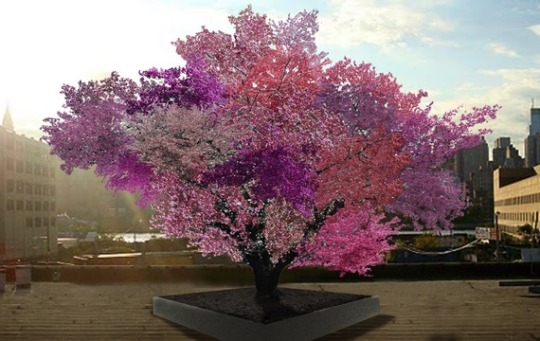
Sounds like y’all’ve never heard about the Tree of 40 Fruits. Well, it’s exactly as it sounds. Sam Van Aken, an artist based in New York, decided to try his hand at grafting (e.g. the process by which you attach the branches of a different tree to a host tree).
As artists are inclined to do he decided to push some limits and over the course of a few years he grafted over 40 different fruit onto the host “
including almond, apricot, cherry, nectarine, peach and plum varieties.”
It has a fruiting period lasting from July to October and this is what it looks like when blossoming.
Shit’s tight yo.
Also we have a group called the Guerrilla Grafters. A group who started in San Fransisco with the goal of grafting fruiting branches onto non-fruiting trees of the same type.
Most cities have fruit trees that simply don’t produce fruit because having all these would be a mess and inadvertently providing unregulated food to people comes with a lot of legal risks I suppose. These grafters seem to think otherwise and have taken it upon themselves to try and bring fruit trees back to urban areas.
HOLY SHIT
THE LAST ONE
Also of note: Cities’ refusal to plant only non-fruit-bearing trees are only planting male trees: aka the pollen producers. So the guerrilla grafters are providing food AND cleaner air!
– They clean your air – They give you something to name – They give you something to take care of – They teach you about care, needs, and resources – They make you look like you’re good at decorating
Here are some of mine:
But some people, because they’re overwhelmed or simply can’t figure out how to start, think that plants are out of their reach.









 DarkestElemental616