the funniest thing in the entire pirates of the caribbean series is definitely that one scene in At World’s End where they have parlay but davy jones is part of it, and rather than have him stand in the shallows or something they get a big bucket of water and have in stand on it on shore
who thought of that idea? who thought “put davy jones in a bucket of water” and had the guts to suggest it aloud? and then who went “hey that sounds like a great idea!”
at some point someone told davy jones their idea was for him to stand in a bucket of water and he agreed to it
*stands majestically in a bucket*
ok but notice the trail of buckets behind him meaning he walked from the ocean through three other buckets of water before he got into the one hes standing in
It’s even funnier when you consider how he must have figured all this out in the first place.
Some folks are asking “well, if he can avoid the no-dry-land curse simply by standing in a bucket, doesn’t that ruin his whole motivation?”, but he’s not on dry land here.
The parley takes place on a sandbar – which, for the unfamiliar, is a temporary “island” of sand deposited by breaking waves, unconnected with the shore, that spends most of its time submerged, being exposed only at low tide.
What Jones is doing here is rules-lawyering his curse. Can you imagine the trial and error he must have gone through in order to determine that this would actually work?
“Okay, do islands count as dry land? How about parts of the shore below the high tide mark? Reefs? Shoals? What if I stand in a pool of water on a shoal? Does it have to be seawater, or will any water do? Does it have to be a natural tidepool, or can it be something artificial, like a bucket?”
What I am saying is that there must have been a process.
Pretty sure that this implies that the reverse – a bucket of sand, floating on the water (big bucket with just a bit of sand), would qualify as dry land. That’s absurd, so I’m pretty sure that his lawyer pulled a fast one over the curse governor.
It may be absurd, but the text of the film bears it out. Davy Jones can sense the presence of his heart while it’s at sea, but not while it’s on land (indeed, that’s why he buried it on land in the first place: to break his connection with it) – yet placing the heart in a simple jar of dirt conceals it from Jones’ awareness just as surely as burial on land does, even if the jar is on a boat at the time. Suitably prepared vessels filled with dirt absolutely count as dry land for the purpose of Jones’ curse.
Then the reverse should also be true. If he buried it in a jar of water, no matter how far inland it is, he would be able to sense it. So by this logic, any container of seawater counts as not dry land, ergo, the bucket is a perfectly viable loophole.
Not necessarily. It’s traditionally a lot easier to accidentally get whammied by a curse than it is to weasel around it – I figure that’s why he’s using multiple layers of indirection here. He’s forbidden to set foot on dry land, but it’s technically not dry land (it’s a sandbar, a non-permanent landform exposed only at low tide) and he technically didn’t set foot on it (he’s standing in a bucket of water). It’s entirely possible that either one of those things alone wouldn’t make the grade.
okay but this all raises one further, very important question: if it’s specifically “dry land” he’s forbidden from, what about wetlands.
can Davy Jones fight you in salt marshes? can he throw down in a peat bog?Swamp Battle?
This is the quality content I come to Tumblr for.
could he step on land if his shoes are wet?
No matter how ridiculous PotC gets I will love it. Especially when it results in conversations like this
What if he crawls around on his hands and knees, with his feet raised slightly into the air? Can he walk on his hands? Can he ride around in a litter or a wheelchair?
can he be in a wheelbarrow?
What if he flies over dry land? Like in a hot air balloon, or in the claws of a giant bird?
What if he’s carried by two swallows using a strand of creeper?
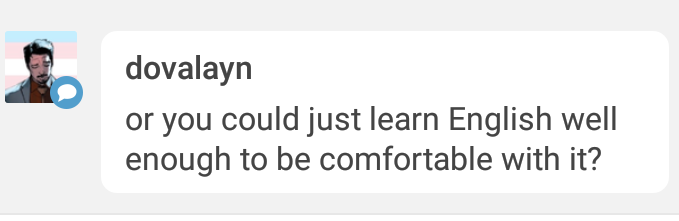
Sometimes I wonder if native English speakers appreciate how much more comfortable the internet is for them than for the rest of the world
Like, you can go on tumblr and simply read stuff in your mother tongue? Amazing. Go on youtube and you don’t have to replay some sentences ten times to try to understand what they’re saying? Incredible. Look for practically anything on google and know that there will be a fuckton of results that you can read without having to spend half the time looking up words in a dictionary? Fascinating. Make a post or send an ask without panicking that you’ll make a silly mistake or that they won’t understand what you meant? Unbelievable.
@dovalayn I did. I’ve studied English for about 10 years and I have the official diploma for the C2 level (the maximum for a non-native speaker) given by the University of Cambridge.
But it’s still my 3rd language and there will be always things that escape me, mainly the slang. Always. Because you know you are always less than the majority. And it’s tiring.
That’s all I’m saying. It would be nice for once to not have to make the effort. And effort is something that no matter how many years of English class I take will always be there.
But not everyone can do that. Some people can’t afford private English academies or are bad at languages, and they should still be able to exist online as well. Why are you so bothered by people not speaking English perfectly? Or by people posting on the internet in other languages??
Since you think my English isn’t good enough, I’d like to see how you do in your 3rd language, and if you don’t get tired after a while 🤷♀️
I hope @no-passaran doesn’t mind me going on a sort of tangent here, but the fact English is a lingua franca is, like it or not, permeated by features of linguistic imperialism.
Native English speakers are used to having the world, and by extension all non native speakers, accommodate to their language. If someone doesn’t know English then said person is uneducated, isn’t wordly, is not qualified enough. If a person doesn’t pronounce English like a native, they’re pronouncing it wrong. Tourists are expected to speak perfect English and be proficient in it to avoid any inconvenience to native English speakers when travelling abroad to English speaking countries (USA and UK particularly, yet interestingly enough we are demanded to speak in English when these people visit our countries). These are all mindsets and situations that exist and are part of the broader context, in which English does operate on linguistic imperialism grounds on a global scale; I’m going to quote Phillipson really quickly:
It’s… interesting, for the lack of a better word, how non native English speakers must even accommodate to native English speakers, when in actuality non native English speakers far surpass natives by several millions and, if anything, it should be them who ought to change, not us.
English becomes our second/third/etc language, we use it with several degrees of proficiency, being affected all the time by our L1, or all the other languages that we might know, we are constantly building on our current interlanguage and gaining a better grasp on how to operate with English. When we talk or chat with other NNE speakers with whom we don’t share a language, we make ourselves understood, we manage to sort any misgiving in communication, if we make a mistake we re-phrase, re-arrange, express things in another way. We are communicating, we still get our messages across despite some slips of the tongue, little mistakes or even a few errors here and there.
We are able to engage, through the use of English, in cross-cultural exchanges, in cross-linguistic exchanges that are allowed by using English as a lingua franca. We are making the language ours, we’re reclaiming the language that for so long was used to shush us down and we’re using it as an asset, we’re using it as a weapon, we’re using it so our voices cannot be silenced any more.
Our messages do get across, they can be understood. When native English speakers claim our Englishes aren’t clear, or we aren’t making any sense, they are really not making the extra effort. In short, many are uncapable of cross-linguistic and cross-cultural exchanges and communication. It’s easier to say we don’t make sense, and by extension snuffing us out, than paying attention to what we are saying.
And we don’t only have to defend our languages and our cultures in a globalised world (in which the normalised culture is that of the center), but we also have to use English as a tool for doing it.
And we should be allowed to express ourselves, exist online without having to constantly accommodate to native English speakers. Because no matter how good our English is, how proficient we are, someone is always going to argue we aren’t good enough, that we aren’t trying hard enough.
This makes me think of a theological debate I once had online – of course in English. The person I was talking to brought the wonderful argument that since I wasn’t a native speaker, I obviously didn’t understand what she was saying and therefore my arguments were invalid.
Yes. Obviously, while I’m writing university papers on Shakespeare in English and talking to you about eschatology in English, I’m actually just pretending to understand what I’m doing, and any disagreement with you must come from me not getting it because my grasp of the language is insufficient.
old people really need to learn how to text accurately to the mood they’re trying to represent like my boss texted me wondering when my semester is over so she can start scheduling me more hours and i was like my finals are done the 15th! And she texts back “Yay for you….” how the fuck am i supposed to interpret that besides passive aggressive
Someone needs to do a linguistic study on people over 50 and how they use the ellipsis. It’s FASCINATING. I never know the mood they’re trying to convey.
I actually thought for a long time that texting just made my mother cranky. But then I watched my sister send her a funny text, and my mother was laughing her ass off. But her actual texted response?
“Ha… right.”
Like, she had actual goddamn tears in her eyes, and that was what she considered an appropriate reply to the joke.I just marvelled for a minute like ‘what the actual hell?’ and eventually asked my mom a few questions. I didn’t want to make her feel defensive or self-conscious or anything, it just kind of blew my mind, and I wanted to know what she was thinking.
Turns out that she’s using the ellipsis the same way I would use a dash, and also to create ‘more space between words’ because it ‘just looks better to her’. Also, that I tend to perceive an ellipsis as an innate ‘downswing’, sort of like the opposite of the upswing you get when you ask a question, but she doesn’t. And that she never uses exclamation marks, because all her teachers basically drilled it into her that exclamation marks were horrible things that made you sound stupid and/or aggressive.
So whereas I might sent a response that looked something like:
“Yay! That sounds great – where are we meeting?”
My mother, whilst meaning the exact same thing, would go:
‘Yay. That sounds great… where are we meeting?”
And when I look at both of those texts, mine reads like ‘happy/approval’ to my eye, whereas my mother’s looks flat. Positive phrasing delivered in a completely flat tone of voice is almost always sarcastic when spoken aloud, so written down, it looks sarcastic or passive-aggressive.
On the reverse, my mother thinks my texts look, in her words, ‘ditzy’ and ‘loud’. She actually expressed confusion, because she knows I write and she thinks that I write well when I’m constructing prose, and she, apparently, could never understand why I ‘wrote like an airhead who never learned proper English’ in all my texts. It led to an interesting discussion on conversational text. Texting and text-based chatting are, relatively, still pretty new, and my mother’s generation by and large didn’t grow up writing things down in real-time conversations. The closest equivalent would be passing notes in class, and that almost never went on for as long as a text conversation might. But letters had been largely supplanted by telephones at that point, so ‘conversational writing’ was not a thing she had to master.
So whereas people around my age or younger tend to text like we’re scripting our own dialogue and need to convey the right intonations, my mom writes her texts like she’s expecting her Eighth grade English teacher to come and mark them in red pen. She has learned that proper punctuation and mistakes are more acceptable, but when she considers putting effort into how she’s writing, it’s always the lines of making it more formal or technically correct, and not along the lines of ‘how would this sound if you said it out loud?’
the linguistics of written languages in quick conversational format will never not be interesting to me like it’s fascinating how we’ve all just silently learned what an ellipsis or exclamation mark implies and it’s totally different in different communities or generations or whatever
I remember in high school, the early 2000s, my friends and I would still pass notes. Well, we would pass a single piece of paper back and forth with conversation. Not only did we use conversational English, but since we were all artists and weebs, we also had little chibi avatars on the side conveying additional emotions. Nothing fancy, just a cute face and a pair of hands if needed, but it’s fascinating to see how even that has developed. Even before chat and emojis were widely used, we were using them in written conversations for clarity.
Hello fam. This is a post brought to you by aPatreonrequest—I know, it’s been a while since I’ve done one of these—from Sarah G, asking my thoughts and opinions on theZero Waste movement that is sweeping across certain parts of the online strata,
particularly on youtube and pinterest. (Links are in bold for ease of
access and viewing, and are non affiliated.)
Sarah writes: Hi Joy, I know this isn’t exactly in the realm of vampires (can’t wait for Phangs!) but I feel this is something you might have some good advice on if you have the spoons to talk about it. I recently started looking into more eco-friendly ways to live after your posts about allergies and toxic synthetics made me realize I had several things in my home that were triggering my asthma and I came across the concept of zero waste, which sounded really cool at first, and then I looked into it some more and it just sort of seems fake and I was wondering what your thoughts were on it.
Zero Waste is indeed something I’m familiar with, and like you, I have mixed feelings on the community around it. The principles of Zero Waste i.e. reducing the amount of waste you produce an the types of waste you produce, are great. I think it’s a solid, good idea to try and promote more ethical produce and buying habits, both for the planet and from a personal financial stand point. The more you can reuse and recycle the better. But I also feel the … fandom (can you call it that???) can be quite off putting and at times extremely self righteous and judgemental in attitude. Amidst the crunchy hippies, the minimalists and those just straight up trying to live a little better, are those who have managed to make something meant for the betterment of the planet into something about themselves, and they’re willing and ready to make sure we know just how evil we are for still having plastic straws with our drinks. Cause, y’know, it’s not big companies doing the most damage to the environment, no sirree it’s you and your plastic water bottle, you monster. (Don’t worry, we’ll get to why the war on plastic is being handled wrong.)
Yea, those people are very fake and very off putting, and I see a lot of them on youtube. And a lot of the time, they’re actually giving contradictory advice toward actually living a zero waste lifestyle.
When talking about this with other people, I have taken to calling this The Mason Jar Aesthetic.
A while ago, while I was talking about sustainable living with a friend (hi Michael!), and he mentioned that he and his wife were thinking of using mason jars as an alternative to buying expensive glassware, because if one breaks, you’ll always be able to replace them easily and you’ll always have a matching set. Which blew my mind as genius because not only is that a super cost effective, but it’s also a really sustainable way of living, both from a zero waste ethic standpoint and financially too.
For example, where I am in the US, for $15 I can usually get 12 half pint mason jars, if not for less depending on where I shop. They come with lids and seal top discs, which are easy to replace if I ever use them for canning and can also be safely frozen, sanitized and reused again and again, meaning they are long lasting and multi-purpose. And, if you are using them as drinkware and this is important to you, they all match.
For me however, the real benefit of the humble mason jar, is that they can be fully recycled, though it is important to note that in some regions, the tops may need to go to a separate facility from the glass jar itself, so you’d need to check with your local recycling center on that. But regardless, the whole thing is recyclable, sturdy, multi-purpose, easily transportable (seal your drink and off you go!), cost effective, and some may even argue, aesthetically pleasing.
Pinterest certainly seems to think so:
[ID: a screenshot from the website Pinterest depicting many diy crafty projets for home and the kitchen involving mason jars]
Some of the larger pint ones, would also fit nicely into a mobility aid like a cup holder, for those of us who need easy to grip handles. (Also as an aside, if you need more stability and often lament that there is no such thing as a two handed mug—or even if you find most mug handles too small to get a good grip—those things are great, they just clip right on. Life changing.) Because if your argument for sustainability isn’t inclusive, it’s not good enough.
Which is where the war on plastic comes in. Looking at you “lets ban all drinking straws regardless of the fact that plastic straws are a vital necessity for some people with disabilities”, and no, pasta straws are not a safe alternative for everyone (allergies/celiac), metal is expensive and also inflexible, and neither are the bamboo, glass or silicone ones. Banning plastic straws at this moment in time, is not the solution.
Brighter minds than mine have tried to solve this, but as a general proposal, instead of an outright ban, until a sustainable and disabled friendly alternative is found, plastic straws in food establishments could be issued by request, without—and this is important—without shaming disabled people for needing to use something which you can easily opt to avoid if you desire to do so. Because once more kids and with feeling, if your argument for sustainability isn’t inclusive, it’s not good enough.
(I am fully prepared to get hate over this, the arguments over this shit on twitter were wild. And no, it is not the responsibility of disabled people to come up with a solution to this, while subsisting on restricted income, restricted access to resources, and often times restricted mobility to boot. If you feel this strongly about disabled people using plastic straws, be part of the solution that helps to find a valid alternative. You want this problem fixed, you do it inclusively.)
Now, where was I, oh yeah. Mason jars.
By contrast, a box of 4 glass tumblers of roughly the same volume, can be anywhere from $10-$20 or even more depending on where you look. And while they might look nice, they are single purpose, expensive, and also—and this is important, cause not a lot of people know this—cannot be recycled.
But Joy, you say, waiting to throw the shards of the broken glass you just swept up off the floor into the recycling, how much damage can it really do? Glass is just glass? Right?
Well, here’s the thing about this type of glass. In order to make it thin and aesthetically appealing, it has to be treated with special chemicals (like molten potassium nitrate) to toughen it up and make it shock resistant to temperatures. The problem with this however, is that treated glass, doesn’t melt at the same temperature as untreated glass, which can cause several problems at recycling facilities, ranging from damaged equipment at the plant (not good!) to creating flawed, glass which is too fragile for use, and will ultimately, you guessed it, end up on the landfill. [Source] The same is true of mirrors and glass from doors and windowpanes. [Source]
So if you do drop your glass and it breaks, please don’t put it in the recycling, wrap it up in brown paper and throw it in the trash. Similarly, if you are sick of the sight of your old glassware, don’t pitch it. Instead consider giving it to goodwill or your local equivalent. Someone will use it.
And don’t feel bad if you didn’t know. I never knew this either till a while ago, but it made me really think twice about how non-eco-friendly and sustainable my home life is. And I’m not saying this to guilt anymore or make you feel bad that you don’t do more, heck knows I never used to give a crap about any of this stuff until I started getting sick and developed multiple chemical sensitivities (Hi if you’re new here, I’m allergic to the modern world due to some frankly dystopian levels of auto-immune problems that emerged in the last few years, send help) and realized just how very not good a lot of the things I was doing are, for both me and the planet.
I am not a crunchy hippy by choice, but by necessity of survival. You have to be when plastics and most mattress fillers and couch stuffing starts bringing you out in a rash/makes you wheeze and suddenly you find yourself wandering the aisles of “eco-friendly" stores wondering if the sales rep you’re listening to actually knows what they’re talking about or if they’re a tinfoil hatter who also puts essential oils in their drinking water. (We’ve been over this, do not.)
But do you know what I also noticed in those supposedly eco-friendly stores?
Mason jar drinkware being sold at $20 a pop. Surely, I thought to myself, surely it’s $20 for a set of at least four?
Nope.
And do you know what else? This wasn’t just a regular mason jar glass that had been tinted blue, no, this was “treated shock resistant glass”. So what they did was, they took an iconic recyclable object that is actually very cheap to produce and buy, inflated the cost by a huge amount, and then, made it non-recyclable, for profit.
Are-you-freaking-kidding-me?
And that’s a huge problem I find, with trying to find information and resources online about sustainable living and eco-friendly products, because a lot of them? Are actually hugely wasteful if not in actual material, then certainly in mentality.
I watched one notable youtuber vlog about how she got rid of everything in her kitchen and replaced it with more eco-friendly (and extremely expensive) options, because she just couldn’t stand the thought of those "toxic" things being in her kitchen … except … they weren’t doing her any harm, and they weren’t worn out. They weren’t falling apart. They were still very much safe and usable and might even have been donated to somewhere like goodwill for someone else to use … but she threw them out to replace them with shiny bamboo and kitschy ceramics, and now they’re heading toward a landfill, where they will not be used to their fullest extent, and where they will pollute the earth.
Surely by the zero waste ethos, it’s more sustainable to use the product until it has to be replaced, and then buy the eco-made alternative?
To give you an example, I’m in the process of replacing all my tupperware with glass, metal and ceramics because I’m allergic to plastics, but also because I’d like to invest in more sustainable planet friendly options for the future. But I’m also doing it once piece at a time. Partly because my husband can and does still use those things, but also because, well, I can’t afford to replace them all. I just plain can’t, it’s too expensive to go out and replace all my leftover food containers with stainless steel lunch boxes from Japan. I’d like to, and I wish I could, but if wishes were horses then I’d need a much bigger yard. (That’s how that saying goes, right?)
I guess the point of this lengthy ramble, is a complaint that the aesthetic of sustainability is actually more popular than actual ethical sustainable practices. Too many people are concerned with looking like they care, but don’t actually want to get into the nuance of things. And I get it, I do. It’s nice to feel like you’re doing something good. Who doesn’t want to feel like they’re taking responsibility for their time on this earth and being the best version of themselves?
But it has to require thought, and method, and looking beyond the narrow scope of your own four walls (metaphorical or otherwise) and what that one person on youtube said, while merely swapping one form of consumerism for another because it looks and feels ethical, but not actually exacting any kind of global change.
And that’s the difference between using a mason jar to drink out of, and the Mason Jar Aesthetic. Being aware of your impact on the earth and doing what you can within your limits and means (and respecting the means of others), vs wanting to be seen as such. And it’s an important distinction and one that requires self reflection and a great deal more thought than buying into an aesthetic.
Me switching out all my plastics and turning my backyard into a compost heap might make my home more eco-friendly, but real change cannot be effected without also putting pressure on large corporations (looking at you Nestle) to change their practices, and boycotting those stores in favor of expensive organic and “ethical” brands is not the solution to this. It merely creates a niche market where the rich and privileged are able to live in a very small self-contained bubble of moral “eco purity”, while actively punching down at those who cannot. Real change? Comes from getting involved in the community and lobbying against big corporations like Nestle turning round and extracting water from drought stricken states, and then selling it back for profit. It’s boots to the ground, and writing letters and emails, and doing more than just buying organic bamboo washcloths and telling yourself you saved the world one micro-bead of plastic at a time.
So do I think zero waste is a crock? Absolutely not, at the core it has some great points about how we use and consume products, which are things we should be thinking about in our day to day lives. But do I feel it places too much emphasis on the self rather than the global community? Absolutely. And at it’s core sustainability isn’t about the self. It’s about community, and the changes we can affect together in order to make the world a little better than how we found it.
Otherwise it’s just survivalism with a rose tinted aesthetic.
What do you guys think? Does anyone have anything to add? Let me know in the comments and see if we can get a discussion going. Also, if you’d like to see more of these types of posts, Patreon subscribers can expect to see them two weeks earlier than tumblr, and get a say in what we discuss, so if you’d like to see me talk about something, let me know 🙂
It’s wild to me, the people who are willing to stan things like big pharma and health insurance companies in the US like somehow the cost of things isn’t arbitrary and absolutely made for profit.
Just saw a comment that said “I don’t think people realize how expensive health care actually is, it’s not like pill companies are out to make a profit” like, I’m sorry, my migraine meds which I can get for free or for a significantly lower cost in nearly every other country in the world, would cost me $120 per month in the US if I chose to fill the prescription. And yes, that’s generic. And yes, that’s with health insurance. My health insurance doesn’t cover them.
My epi pens, a literal life saving rescue med, if I can’t get a generic non auto-injector or if I don’t have a coupon, can cost me $600 per pen. And you’re supposed to carry two and replace them yearly.
For that price I can literally fly home to the UK for two weeks and have them replaced for free (I’m a UK citizen before anyone gets their knickers in a bunch about freeloading scroungers), and still have an extra $100-400 to play with depending on the time of year I fly out.
I literally plan trips home based around when my meds need refilled, because it’s works out cheaper than trying to get a pharmacy in the US that takes my insurance and provides generic non automated adrenaline pens.
That’s fucked up.
And it is absolutely because health insurance companies and “big pharma” are in cahoots over how much profit they want to make from tragic events and debilitating illnesses. Meanwhile people die cause it’s a choice between food for their kids or insulin for their diabetes.
But go off I guess.
Another thing that ticks me off is people who go “oh just get new insurance if yours is too expensive” like I didn’t already think of that, and am also not restricted with who will cover me because I’m an immigrant.
Cause oh yeah, that’s a thing.
Anyone that says “well immigrants come here to get free healthcare” are absolutely talking out of their asses.
“Oh but we meant the illegals…” except you cannot get Medicaid or state equivalent without an official alien green card number??? So that’s false???
“But I heard…” well ya heard wrong.
Free health care is such a weird phenomenon to me.
We have state clinics, which are cheaper than private hospitals. You still pay for your treatment though. Medical insurance is ridiculously expensive, and not a “Benefit” with most jobs in my country. You’re lucky if you land that gig.
My husband tore a ligament a year back, we carted him off to the state hospital, he sat in line for 9 hours, had a quick xray to confirm and was sent home with aspirin. That was the extent of the help he got.
I had my wisdom teeth removed in a private hospital. I’m deathly allergic to tramal, which is the painkiller they inject you with after you come out of surgery. Noted on my chart and medical alert bracelet. I felt confident that the doctors wouldn’t inject me with the thing that could kill me.
I guessed wrong.
If I hadn’t asked the doctor what he was injecting me with ( still high on anaesthetic, fyi) he would have killed me. Do you know what he said to me when I told him I was allergic? “HOW allergic?” 😐.
Pharma companies, healthcare in general? No one cares. Pay, don’t pay. You’re going to suffer regardless. All that matters is how much money they can make off of you.
‘Free’ healthcare isnt all its made out to be. The british NHS will do everything they can to blame YOU for anything that is wrong or that you need treatment for. If your BMI is over the optimim 18 to 25 points you’re screwed. Flu? Too fat. Broken Ankle? Too fat. Polycystic Ovaries? Too fat. Asthma? Too fat. Everything you would not have if you lost weight. Oh you have despression and are self harming? Well if you lost weight… do you see where this is going?
Also prescriptions; in Scotland and Wales prescriptions are free. But in England unless you have a medical exemption card you’re paying. I have asthma and regularly have to replace my inhalers for various reason; lose them, break them, they run out. I earn less than £7k a year so i earn less than someone who claims benefits. The one exception is if they are what are classed as ‘life saving drugs’ you dont have to pay.
Doc: If you dont carry your inhaler and have an attack you’re screwed and could die.
Me: Oh ok. So can i get a medical exemption card? These things are getting expensive.
Doc: Nope
Me: But you said if i dont have my inhaler i could die from an asthma attack.
Doc: Exemption cards are only for Life Saving Drugs.
Me: But you just said i have to carry my inhaler or else i could die. It could literally save my life.
Doc: Nope. Inhalers arent considered life saving drugs.
Me: but…
Oh and lets get onto mental health care. I was diagnosed with post natal depression after i lost my first child. That then turned into the fairly rarely diagnosed pre-natal depression when i was pregnant with Superpup.
After he was born the trauma of his birth and the isolation that came with being a new mother tipped me back into severe post natal depression again. I found the strength to seek help and my GP referred me to a state shrink…
I walk into his office and before i’ve even sat down he comments that he wished new mums didnt bring their babies with them. Then he told me (not asked) to tell him the history, asked some very emotionally painful questions before telling me to ‘snap out of it before you get committed’.
He then suggested i would feel better if i lost weight and was happy to write me a prescription for amphetamines that would make me very active and happy.
I told him to fuck off and stormed out.
So no, free healthcare isnt all its cracked up to be.
Oh friend. I got news for you. Private for cost care doesn’t remove any of that shit.
It just means I’m getting charged $500 per 20 minute appointment to be told it’s my fault.
That isn’t a money or cost issue, it’s a systemic ussue of the sexism, the racism and ableism that is permitted to run riot in the medical world, regardless of cost.
So, to sum up, healthcare is fucked everywhere.
Fucked but not unfixable. Likely not to any benefit of my lifetime, but we don’t always get to see the forests we burn down to regrow.
*Nods*
I’m in the US. I have what’s considered “good” health insurance (I’m lucky, my husband has a state union job). This does not do much to cover mental health services though. I mean, technically it’s covered but most therapists won’t take it because it pays them so little.
But moreover, it has protected me from shitty healthcare on the medical side. I’ve got what turns out to be a mixture of panic disorder and something called Postural Orthostatic Tachycardia Syndrome aka POTS (basically my heart rate goes way up from standing-it is SUPER easy to check for).
The first doctor barely checked me over and was like, “You have chest wall pains, go on this steroid.”
Friends, do you know what you really shouldn’t give someone with an overly fast heart rate and panic attacks? If you guessed steroid, you know who ended up in ER two days later, baffling doctors with her freakish racing heart, shortness of breath, and chest pain.
The drama goes on for quite a while after this, and includes a lot of doctors brushing me off and one yelling at me because I stopped taking antidpressents because they gave me suicidal thoughts.
My take on the problem (at least in the US, having never received medical care in another country)?
1. Medicine is for profit now, not for people.
2. Doctors have no training on dealing with people.
3. Doctors are only allowed a few minutes per patient.
Also, as a medical professional, I would like to add on to the “HOW allergic are you?” question, because if you only experience minor swelling or irritation, they can usually toss in an antihistamine and let the drug do its job. If it’s worse, then they abso-fucking-lutely need to step up their game (and naturally, allergy profiles don’t have that kind of nuance to them in computer systems, so we gotta ask every time). I’ve had to verify with doctors and patients concerning various penicillin and opoid allergies and not all of them were fatal reactions.
Allergic reactions can vary from minor redness and swelling to anaphylaxis, and please keep in mind that even if our allergy profile for you is updated, there is no way for us to keep track of the severity. Some of us go to one extreme and avoid it completely, others will be asking how allergic you are. And since our hours are constantly being cut, we don’t have the staff or the time to help everyone the way we want to help them, the way they need to be helped.



 DarkestElemental616