oxfordcommaforever:

phroyd:

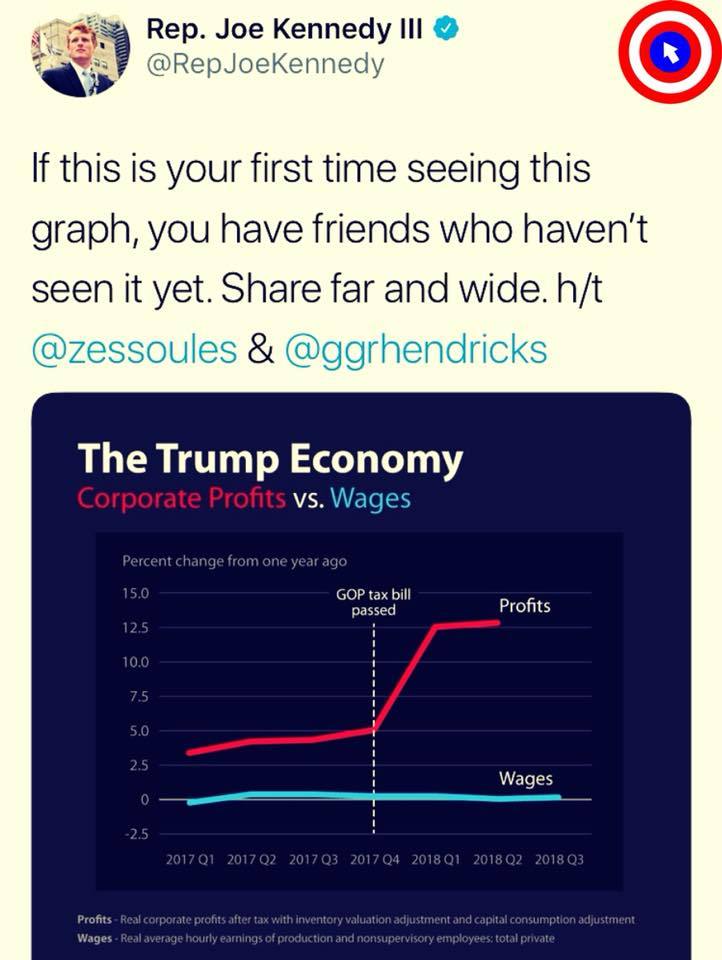
Yes, Increased profits Will Create More Jobs and Higher Wages!

Bullshit!  Not in A Republican Universe!

Phroyd

Increased profits actually DO CREATE JOBS!

WHEN THERE IS 75% TAX ON BUSINESSES!

Because if they invest in factories, jobs training, new materials, etc they get to write off said income and pay lower marginal tax rates.

Aka what happened in america between 1940-1985

NEVER LET THESE FUCKERS TELL YOU ITS SOCIALIST PROPEGANDA; ITS THE ECONOMICS THAT BUILT MODERN AMERICA!

heroofthreefaces:

smarter-than-the-republicans:

tilthat:

TIL after a millionaire gave everyone in a Florida neighborhood free college scholarships and free daycare, crime rate was cut in half and high school graduation rate increased from 25% to 100%.

via reddit.com

That’s ONE millionaire. Imagine what all millionaires and billionaires could do for this country if they actually put their obscene wealth to practical use.

this is why you fucking tax the rich folks

Trump and the End of Antitrust

robertreich:

The
Trump Justice Department has approved a $69 billion merger between CVS, the nation’s largest drugstore chain, and insurance giant Aetna. It’s the largest health insurance
deal in history.

Executives say the combination will make their
companies more efficient, allowing them to gain economies of scale and squeeze
waste out of the system.

Rubbish. This is what
big companies always say when they merge.

The real purpose is
to give Aetna and CVS more bargaining power over their consumers and employees, as well as pharmaceutical companies and healthcare providers (which
have also been consolidating).

The result: Higher prices. Americans already
spend far
more
on healthcare and medications per person than do citizens in any other
developed country – and our health is among the worst.

America used to
have antitrust laws that permanently stopped corporations from monopolizing
markets, and often broke up the biggest culprits. 

But now, especially with Trump as president and lobbyists and CEOs running much of the government, giant corporations like Aetna and CVS are
busily weakening antitrust enforcement and taking over the economy.

They’re also keeping down wages. Workers with less choice of whom to work for have a
harder time getting a raise. So when local labor markets are dominated by one
major drug chain like CVS or one big box retailer like Walmart,

these firms
essentially set wage rates for the area. 

These massive
corporations also have a lot of political clout – another reason they’re
consolidating.

We see the same pattern across the economy. Wall Street’s five largest banks now account for 44
percent
of America’s banking assets – up from about 10 percent thirty years ago. That means higher interest rates on loans, higher
late fees, and a greater risk of another “too-big-to-fail” bailout.

But politicians
don’t dare bust them up because Wall Street pays part of their campaign
expenses. 

Oh, and why does
the United States have the highest broadband prices among advanced nations and
the slowest speeds?

Because
more than 80 percent
of Americans have no choice but to rely on their local
cable company for high capacity wired data connections to the Internet –
usually Comcast, AT&T, or Verizon. And these corporations are
among the most politically powerful in America.

(In a rare exception to Trump’s corporate sycophancy, the Justice Department is appealing a district court’s approval of AT&T’s merger with Time Warner.)

Have you wondered
why your airline ticket prices have remained so high even though the cost of jet
fuel has plummeted?

Because U.S.
airlines have consolidated into a handful of giant carriers that divide up routes
and collude on fares. As recently as 2005 the U.S. had nine major airlines. Now
we have just four.
And all are politically well-connected. 

Why does food
cost so much? Because the four largest food companies control 82
percent
of beef packing, 85
percen
t of soybean processing,
63 percent
of pork packing, and 53
percent
of chicken processing. 

Monsanto alone
owns the key genetic traits to more than 90
percent
of the soybeans planted by farmers in the United States, and 80
percent
of the corn. Big Agribusiness wants to keep it this way. 

Google’s search
engine is so dominant “google” has become a verb. A few years ago the staff of
the Federal Trade Commission recommended
suing Google for “conduct [that] has resulted – and will result – in real harm
to consumers and to innovation.” 

But the commissioners
decided against the lawsuit, perhaps because Google is also the biggest
lobbyist in Washington.

The list goes on,
industry after industry, across the economy. Antitrust has
been ambushed by the giant companies it was designed to contain.

Under Trump and the Republicans, Congress has
further squeezed the budgets of the antitrust division of the Justice Department and
the Bureau of Competition of the Federal Trade Commission. Politically-powerful
interests have squelched major investigations and lawsuits. Right-wing judges
have stopped or shrunk the few cases that get through. 

Trump and his
Republican enablers rhapsodize about the “free market,” yet have no qualms about allowing big corporations to rig it to
boost profits at the expense of average people.

We’re now in a
new Gilded Age of wealth and power similar to the first Gilded Age of the late nineteenth century when the nation’s
antitrust laws were enacted. But unlike then, today’s biggest corporations have
enough political clout to neuter antitrust. 

Unless government
un-rigs the market through bold antitrust action to restore competition, the hidden upward
distributions from consumers and workers to corporate chieftains and major investors will grow even larger.

If Democrats ever
get back in power, one of the first things they need to do is revive antitrust.

theactualcluegirl:

sandersstudies:

I don’t want to be rich, I just want to be comfy.

Want to have one really nice set of plates and silverware for company and Thanksgiving.

Want to be able to buy a new outfit and a good bra at least a couple times a year.

Want to be able to give “just because” gifts.

Want to burn incense and candles in my home daily, and have nice soaps.

Want to be able to donate to charity frequently and without worry.

Want to buy hardcover books to read and put on a shelf for my kids to read someday.

Want to have candies in bowls for people who visit.

Want to be able to take my young siblings and cousins to a movie and let them get the big popcorn they won’t finish, because there’s magic in just having it.

Want to have a linen closet or at least a linen shelf.

Want to go see live local theater several times a year.

Want to have a bottle of wine or champagne in the house for when I suddenly need to celebrate.

Want to have a kitchen with basic baking supplies so I can bake bread on the weekend, and pies for special occasions.

I just want to be comfy.

That is my definition of ‘wealth’, as contrasted with ‘excess’.  As my mother in law put it – if I can see a little something in a store that I know a friend would love, and just BUY it for them without having to worry about whether I can afford it in the budget, that means I’m well off.  And that?  That is what I want.

For everyone.  

Everyone.

memecucker:

memecucker:

What I think is really interesting about the papyrus account of the workers building the tomb of Rameses III going on strike to demand better wages is really fascinating to me because if you look at the description given by the royal scribe you see that there was an attempt to satisfy the workers by bringing a large amount of food at once but that was rebuffed by the workers who declared that it wasn’t just that they were hungry at the moment but had serious charges to bring that “something bad had been done in this place of Pharoah” (is poor wages and mistreatment). They understood themselves as having long term economic interests as a -class- and organized together knowing that by doing so they could put forward their demands collectively. It so strongly flies in the face of narratives that are like “in this Time and Place people were happy to be serve because they believed in the God-King and maybe you get some intellectual outliers but certainly no common person questioned that”. If historical sources might paint that sorta picture of cultural homogeneity it is because those sources sought not to describe something true but invent a myth for the stability of a regime.

Since this is getting notes here’s a link to a translation of the papyrus scroll and here’s an article that gets further into the economic situation surrounding the strike and giving an explanation of the events. The workers didnt just refuse to construct Rameses III’s future tomb, they actually occupied the Valley of the Kings and were preventing anyone from entering to perform rituals or funerals. Basically they set up the first ever recorded picket line

Again the workers went on strike, this time taking over and blocking all access to the Valley of the Kings. The significance of this act was that no priests or family members of the deceased were able to enter with food and drink offerings for the dead and this was considered a serious offense to the memory of those who had passed on to the afterlife. When officials appeared with armed guards and threatened to remove the men by force, a striker responded that he would damage the royal tombs before they could move against him and so the two sides were stalemated.

Eventually the tomb workers were able to win the day and acquire their demands and actually set a precedent for organized labor and strikes in Egyptian society that continued for a long time

The jubilee in 1156 BCE was a great success and, as at all festivals, the participants forgot about their daily troubles with dancing and drink. The problem did not go away, however, and the workers continued their strikes and their struggle for fair payment in the following months. At last some sort of resolution seems to have been reached whereby officials were able to make payments to the workers on time but the dynamic of the relationship between temple officials and workers had changed – as had the practical application of the concept of ma’at – and these would never really revert to their former understandings again. Ma’at was the responsibility of the pharaoh to oversee and maintain, not the workers; and yet the men of Deir el-Medina had taken it upon themselves to correct what they saw as a breach in the policies which helped to maintain essential harmony and balance. The common people had been forced to assume the responsibilities of the king.

[…]

The success of the tomb-worker/artisan strikes inspired others to do the same. Just as the official records of the battle with the Sea Peoples never recorded the Egyptian losses in the land battle, neither do they record any mention of the strikes. The record of the strike comes from a papyrus scroll discovered at Deir el-Medina and most probably written by the scribe Amennakht. The precedent of workers walking away from their jobs was set by these events and, although there are no extant official reports of other similar events, workers now understood they had more power than previously thought. Strikes are mentioned in the latter part of the New Kingdom and Late Period and there is no doubt the practice began with the workers at Deir el-Medina in the time of Ramesses III.

spencerthefredder:

uisce-bitch:

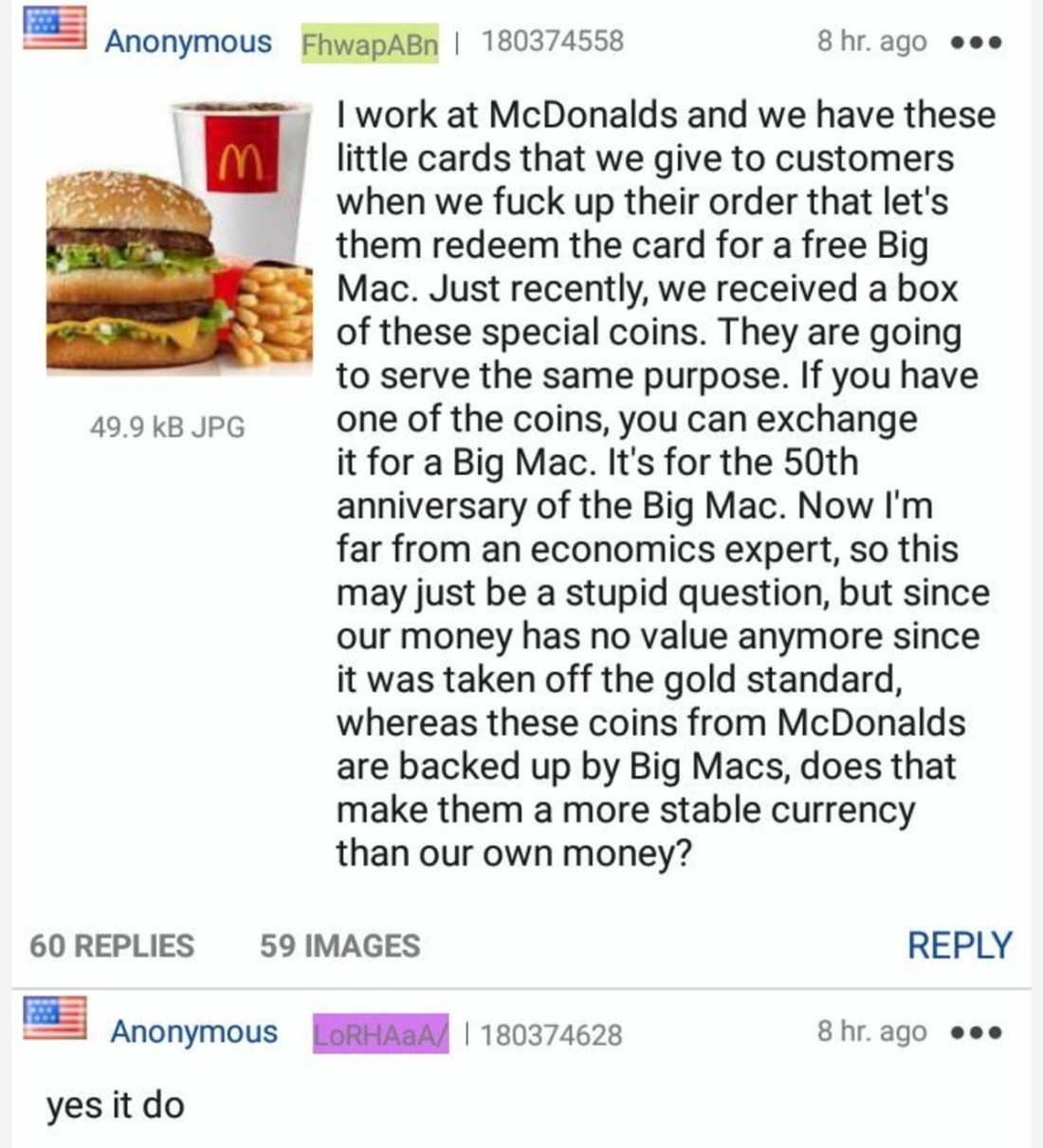
I’m confused

It used to be that paper currency was backed by gold and silver for its value. A 10$ paper note would be redeemable for 10$ worth of gold or silver following the gold or silver standard. Currently our bills are fiat money which means they are not backed by any tangible item. They’re just based on the strength of the economy. The economy can fluctuate so it makes the actual value of a bill unstable. These Mcdonalds coins, however, would be a currency that are redeemable for a Big Mac. This would make them a technically more stable currency as they are always have the value of a Big Mac they can be redeemed for.