Oh my god, they sprang this on us in our old church years ago, and my family has never let this joke die.
Okay, here’s the stupid gender essentialist metaphor:
Women are like spaghetti because their thoughts noodle all over the place. Men are like waffles because there thoughts are in boxes. Men aren’t bad listeners, they just can’t keep up with a conversation when women are noodling topics so fast and they have to keep switching boxes. Also, when a woman asks a man what he’s thinking and he says “nothing” women just don’t understand that some of a man’s boxes literally have nothing in them, haha!
….. 😐
Anyway, if you think me and my brothers and my mom don’t constantly give each other sad, tragic faces and say “I’m sorry, my waffle box is empty today” and “noodle faster!” and “you are failing at being a waffle” and “I can’t be clearer, I am a plate of spaghetti” pretty much indiscriminately in all directions all the time…. you would be wrong.
Occasionally the context of a Dadaist post makes it even better.
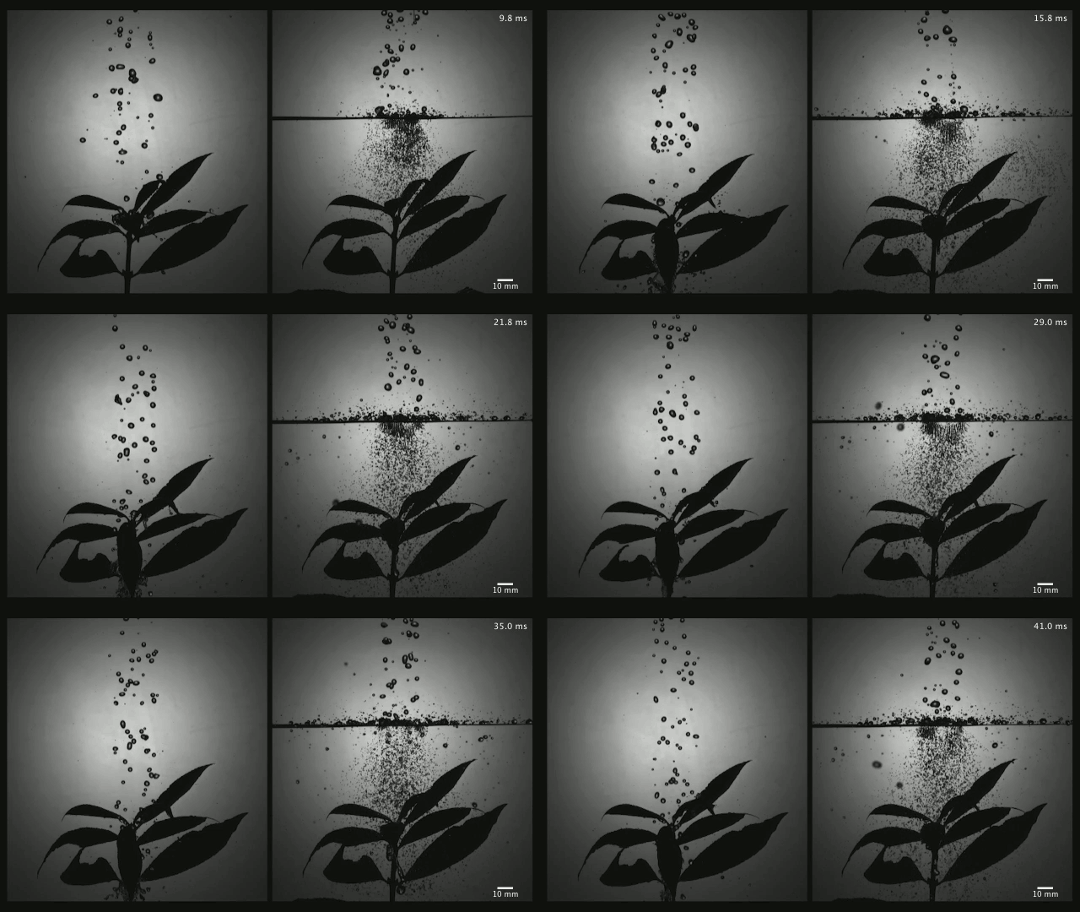
Lots of applications – from rocket engines to ink jet printing – require breaking large droplets into smaller ones, so there are many methods to do this. Some techniques rely on fluid instabilities, others use ultrasonic vibration. But one of the most effective methods may also be the simplest: placing a mesh between large drops and their target.
That’s the idea at the heart of this new study, which uses a wire mesh to break large droplets into a spray of finer ones 1000 times smaller. The target application is agricultural spraying, and the researchers argue that their method would allow farmers to treat their crops effectively with fewer chemicals and less run-off. Drops impacting the mesh form a narrow cone over the plant, and the smaller, slower droplets are better at sticking to the plant instead of bouncing away. They’re also less likely to injure crops, since they don’t disturb the leaves the way larger drops do. (Image and research credit: D. Soto et al.; via MIT News; submitted by Omar M.)
These are two of the most powerful moments in the X-Men movies. This is how you define Magneto. A man scarred and impacted by what he endured in the camps. A man who endured the unendurable.
I never saw him as a villain. I never saw him as a monster. I saw him as a man who wanted to do everything – to move heaven and earth – to keep his people safe.
























 DarkestElemental616