Sometimes I wonder if native English speakers appreciate how much more comfortable the internet is for them than for the rest of the world
Like, you can go on tumblr and simply read stuff in your mother tongue? Amazing. Go on youtube and you don’t have to replay some sentences ten times to try to understand what they’re saying? Incredible. Look for practically anything on google and know that there will be a fuckton of results that you can read without having to spend half the time looking up words in a dictionary? Fascinating. Make a post or send an ask without panicking that you’ll make a silly mistake or that they won’t understand what you meant? Unbelievable.
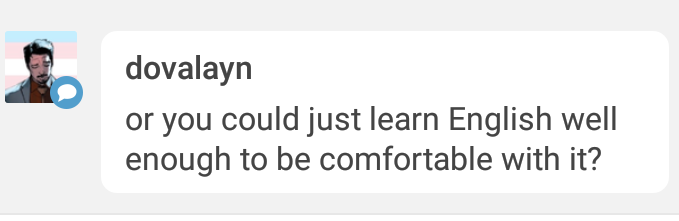
@dovalayn I did. I’ve studied English for about 10 years and I have the official diploma for the C2 level (the maximum for a non-native speaker) given by the University of Cambridge.
But it’s still my 3rd language and there will be always things that escape me, mainly the slang. Always. Because you know you are always less than the majority. And it’s tiring.
That’s all I’m saying. It would be nice for once to not have to make the effort. And effort is something that no matter how many years of English class I take will always be there.
But not everyone can do that. Some people can’t afford private English academies or are bad at languages, and they should still be able to exist online as well. Why are you so bothered by people not speaking English perfectly? Or by people posting on the internet in other languages??
Since you think my English isn’t good enough, I’d like to see how you do in your 3rd language, and if you don’t get tired after a while 🤷♀️
I hope @no-passaran doesn’t mind me going on a sort of tangent here, but the fact English is a lingua franca is, like it or not, permeated by features of linguistic imperialism.
Native English speakers are used to having the world, and by extension all non native speakers, accommodate to their language. If someone doesn’t know English then said person is uneducated, isn’t wordly, is not qualified enough. If a person doesn’t pronounce English like a native, they’re pronouncing it wrong. Tourists are expected to speak perfect English and be proficient in it to avoid any inconvenience to native English speakers when travelling abroad to English speaking countries (USA and UK particularly, yet interestingly enough we are demanded to speak in English when these people visit our countries). These are all mindsets and situations that exist and are part of the broader context, in which English does operate on linguistic imperialism grounds on a global scale; I’m going to quote Phillipson really quickly:
It’s… interesting, for the lack of a better word, how non native English speakers must even accommodate to native English speakers, when in actuality non native English speakers far surpass natives by several millions and, if anything, it should be them who ought to change, not us.
English becomes our second/third/etc language, we use it with several degrees of proficiency, being affected all the time by our L1, or all the other languages that we might know, we are constantly building on our current interlanguage and gaining a better grasp on how to operate with English. When we talk or chat with other NNE speakers with whom we don’t share a language, we make ourselves understood, we manage to sort any misgiving in communication, if we make a mistake we re-phrase, re-arrange, express things in another way. We are communicating, we still get our messages across despite some slips of the tongue, little mistakes or even a few errors here and there.
We are able to engage, through the use of English, in cross-cultural exchanges, in cross-linguistic exchanges that are allowed by using English as a lingua franca. We are making the language ours, we’re reclaiming the language that for so long was used to shush us down and we’re using it as an asset, we’re using it as a weapon, we’re using it so our voices cannot be silenced any more.
Our messages do get across, they can be understood. When native English speakers claim our Englishes aren’t clear, or we aren’t making any sense, they are really not making the extra effort. In short, many are uncapable of cross-linguistic and cross-cultural exchanges and communication. It’s easier to say we don’t make sense, and by extension snuffing us out, than paying attention to what we are saying.
And we don’t only have to defend our languages and our cultures in a globalised world (in which the normalised culture is that of the center), but we also have to use English as a tool for doing it.
And we should be allowed to express ourselves, exist online without having to constantly accommodate to native English speakers. Because no matter how good our English is, how proficient we are, someone is always going to argue we aren’t good enough, that we aren’t trying hard enough.
This makes me think of a theological debate I once had online – of course in English. The person I was talking to brought the wonderful argument that since I wasn’t a native speaker, I obviously didn’t understand what she was saying and therefore my arguments were invalid.
Yes. Obviously, while I’m writing university papers on Shakespeare in English and talking to you about eschatology in English, I’m actually just pretending to understand what I’m doing, and any disagreement with you must come from me not getting it because my grasp of the language is insufficient.

 DarkestElemental616