purronronner:

jewlikeruth:

snorlaxatives:

unculture:

snorlaxatives:

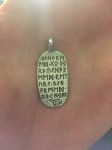
no offense to people named aaron but who the fuck decided two a’s were necessary??? now i can’t converse with someone named aaron without calling them a-aron

not to be That Bitch but it’s another example of an anglicized disaster of a name from biblical hebrew, which was aharon and imo infinitely more badass than aaron

others in this cursed category: elisheva (elizabeth), yirmiyahu (jeremy), mikha-el (michael), matisyahu (matthew), shoshana (susanna)

you really are that bitch huh i feel educated as fuck right now

Here I always thought the double a was a mistake caused by Moses having a stutter.

Aron: Moses, my long-lost brother!

Moses: A-aron, it’s g-good to see you!

Aaron: well I guess that’s my name now

Ay-AyRon

cimness:

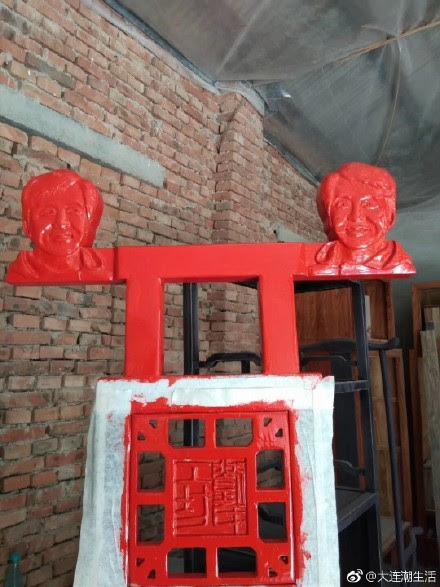
China’s netizens are all in a twitter over the account of a carpenter who was commissioned to make a cinnabar red high-backed chair with the finials at the top to be “in the shape of dragons’ heads” (chéng lóngtóu 成龍頭).  Unfortunately, he misinterpreted the directions to mean “[in the shape of] Jackie Chan’s head” (“Chénglóng tóu 成龍頭”).

(via Language Log » Reanalysis, Jackie Chan edition)

settle this for me once and for all

chromatosis:

thayerkerbasy:

formalsweatpants-casualtiaras:

kaf-kaf-kaf:

lyrangalia:

iviarelle:

startedwellthatsentence:

tvalkyrie:

breadpocalypse:

ilovejohnmurphy:

furryputin:

ilovejohnmurphy:

corntroversy:

ilovejohnmurphy:

is “chai” a TYPE of tea??! bc in Hindi/Urdu, the word chai just means tea

its like spicy cinnamon tea instead of bland gross black tea

I think the chai that me and all other Muslims that I know drink is just black tea

i mean i always thought chai was just another word for tea?? in russian chai is tea

why don’t white people just say tea

do they mean it’s that spicy cinnamon tea

why don’t they just call it “spicy cinnamon tea”

the spicy cinnamon one is actually masala chai specifically so like

there’s literally no reason to just say chai or chai 

They don’t know better. To them “chai tea” IS that specific kind of like, creamy cinnamony tea. They think “chai” is an adjective describing “tea”.

What English sometimes does when it encounters words in other languages that it already has a word for is to use that word to refer to a specific type of that thing. It’s like distinguishing between what English speakers consider the prototype of the word in English from what we consider non-prototypical.

(Sidenote: prototype theory means that people think of the most prototypical instances of a thing before they think of weirder types. For example: list four kinds of birds to yourself right now. You probably started with local songbirds, which for me is robins, blue birds, cardinals, starlings. If I had you list three more, you might say pigeons or eagles or falcons. It would probably take you a while to get to penguins and emus and ducks, even though those are all birds too. A duck or a penguin, however, is not a prototypical bird.)

“Chai” means tea in Hindi-Urdu, but “chai tea” in English means “tea prepared like masala chai” because it’s useful to have a word to distinguish “the kind of tea we make here” from “the kind of tea they make somewhere else”.

“Naan” may mean bread, but “naan bread” means specifically “bread prepared like this” because it’s useful to have a word to distinguish between “bread made how we make it” and “bread how other people make it”.

We also sometimes say “liege lord” when talking about feudal homage, even though “liege” is just “lord” in French, or “flower blossom” to describe the part of the flower that opens, even though when “flower” was borrowed from French it meant the same thing as blossom. 

We also do this with place names: “brea” means tar in Spanish, but when we came across a place where Spanish-speakers were like “there’s tar here”, we took that and said “Okay, here’s the La Brea tar pits”.

 Or “Sahara”. Sahara already meant “giant desert,” but we call it the Sahara desert to distinguish it from other giant deserts, like the Gobi desert (Gobi also means desert btw).

English doesn’t seem to be the only language that does this for places: this page has Spanish, Icelandic, Indonesian, and other languages doing it too.

Languages tend to use a lot of repetition to make sure that things are clear. English says “John walks”, and the -s on walks means “one person is doing this” even though we know “John” is one person. Spanish puts tense markers on every instance of a verb in a sentence, even when it’s abundantly clear that they all have the same tense (”ayer [yo] caminé por el parque y jugué tenis” even though “ayer” means yesterday and “yo” means I and the -é means “I in the past”). English apparently also likes to use semantic repetition, so that people know that “chai” is a type of tea and “naan” is a type of bread and “Sahara” is a desert. (I could also totally see someone labeling something, for instance, pan dulce sweetbread, even though “pan dulce” means “sweet bread”.)

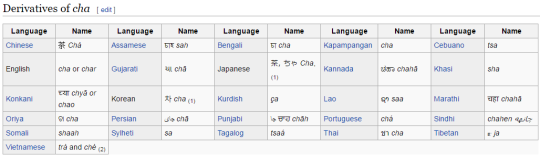
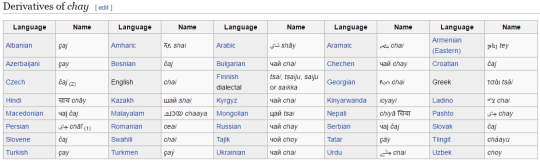
Also, specifically with the chai/tea thing, many languages either use the Malay root and end up with a word that sounds like “tea” (like té in Spanish), or they use the Mandarin root and end up with a word that sounds like “chai” (like cha in Portuguese).

So, can we all stop making fun of this now?

Okay and I’m totally going to jump in here about tea because it’s cool. Ever wonder why some languages call tea “chai” or “cha” and others call it “tea” or “the”? 

It literally all depends on which parts of China (or, more specifically, what Chinese) those cultures got their tea from, and who in turn they sold their tea to. 

The Portuguese imported tea from the Southern provinces through Macau, so they called tea “cha” because in Cantonese it’s “cha”. The Dutch got tea from Fujian, where Min Chinese was more heavily spoken so it’s “thee” coming from “te”. And because the Dutch sold tea to so much of Europe, that proliferated the “te” pronunciation to France (”the”), English (”tea”) etc, even though the vast majority of Chinese people speak dialects that pronounce it “cha” (by which I mean Mandarin and Cantonese which accounts for a lot of the people who speak Chinese even though they aren’t the only dialects).

And “chai”/”chay” comes from the Persian pronunciation who got it from the Northern Chinese who then brought it all over Central Asia and became chai.

(Source

This is the post that would make Uncle Iroh join tumblr

Tea and linguistics. My two faves.

Okay, this is all kinds of fascinating!

Quality linguistic research

A Spectre is Haunting Unicode

allthingslinguistic:

An interesting article about Japanese and Unicode. Excerpt: 

In 1978 Japan’s Ministry of Economy, Trade and Industry established the encoding that would later be known as JIS X 0208, which still serves as an important reference for all Japanese encodings. However, after the JIS standard was released people noticed something strange – several of the added characters had no obvious sources, and nobody could tell what they meant or how they should be pronounced. Nobody was sure where they came from. These are what came to be known as the ghost characters (幽霊文字). […]

By interviewing the catalogers involved in the creation of the standard, the investigators established that some characters were inadvertently invented as mistakes in the cataloging process. For example, 妛 was an error introduced while trying to record “山 over 女”. “山 over 女” occurs in the name of a particular place and was thus suitable for inclusion in the JIS standard, but because they couldn’t print it as one character yet, 山 and 女 were printed separately, cut out, and pasted onto a sheet of paper, and then copied. When reading the copy, the line where the two little pieces of paper met looked like a stroke and was added to the character by mistake. The original character (𡚴) was not added to JIS or Unicode until much later and doesn’t display on most sites for me.

Read the whole thing

A Spectre is Haunting Unicode

rileyjaydennis:

feynites:

runawaymarbles:

averagefairy:

old people really need to learn how to text accurately to the mood they’re trying to represent like my boss texted me wondering when my semester is over so she can start scheduling me more hours and i was like my finals are done the 15th! And she texts back “Yay for you….” how the fuck am i supposed to interpret that besides passive aggressive

Someone needs to do a linguistic study on people over 50 and how they use the ellipsis. It’s FASCINATING. I never know the mood they’re trying to convey.

I actually thought for a long time that texting just made my mother cranky. But then I watched my sister send her a funny text, and my mother was laughing her ass off. But her actual texted response?

“Ha… right.”

Like, she had actual goddamn tears in her eyes, and that was what she considered an appropriate reply to the joke.I just marvelled for a minute like ‘what the actual hell?’ and eventually asked my mom a few questions. I didn’t want to make her feel defensive or self-conscious or anything, it just kind of blew my mind, and I wanted to know what she was thinking.

Turns out that she’s using the ellipsis the same way I would use a dash, and also to create ‘more space between words’ because it ‘just looks better to her’. Also, that I tend to perceive an ellipsis as an innate ‘downswing’, sort of like the opposite of the upswing you get when you ask a question, but she doesn’t. And that she never uses exclamation marks, because all her teachers basically drilled it into her that exclamation marks were horrible things that made you sound stupid and/or aggressive.

So whereas I might sent a response that looked something like:

“Yay! That sounds great – where are we meeting?”

My mother, whilst meaning the exact same thing, would go:

‘Yay. That sounds great… where are we meeting?”

And when I look at both of those texts, mine reads like ‘happy/approval’ to my eye, whereas my mother’s looks flat. Positive phrasing delivered in a completely flat tone of voice is almost always sarcastic when spoken aloud, so written down, it looks sarcastic or passive-aggressive.

On the reverse, my mother thinks my texts look, in her words, ‘ditzy’ and ‘loud’. She actually expressed confusion, because she knows I write and she thinks that I write well when I’m constructing prose, and she, apparently, could never understand why I ‘wrote like an airhead who never learned proper English’ in all my texts. It led to an interesting discussion on conversational text. Texting and text-based chatting are, relatively, still pretty new, and my mother’s generation by and large didn’t grow up writing things down in real-time conversations. The closest equivalent would be passing notes in class, and that almost never went on for as long as a text conversation might. But letters had been largely supplanted by telephones at that point, so ‘conversational writing’ was not a thing she had to master. 

So whereas people around my age or younger tend to text like we’re scripting our own dialogue and need to convey the right intonations, my mom writes her texts like she’s expecting her Eighth grade English teacher to come and mark them in red pen. She has learned that proper punctuation and mistakes are more acceptable, but when she considers putting effort into how she’s writing, it’s always the lines of making it more formal or technically correct, and not along the lines of ‘how would this sound if you said it out loud?’

the linguistics of written languages in quick conversational format will never not be interesting to me like it’s fascinating how we’ve all just silently learned what an ellipsis or exclamation mark implies and it’s totally different in different communities or generations or whatever

I remember in high school, the early 2000s, my friends and I would still pass notes. Well, we would pass a single piece of paper back and forth with conversation. Not only did we use conversational English, but since we were all artists and weebs, we also had little chibi avatars on the side conveying additional emotions. Nothing fancy, just a cute face and a pair of hands if needed, but it’s fascinating to see how even that has developed. Even before chat and emojis were widely used, we were using them in written conversations for clarity.

roachpatrol:

perspicaciousembroiderist:

consolecadet:

shrikestrike:

moggiepillar:

i can no longer take any description of a male protagonist seriously if the writer describes him as ‘brooding’

because i used to think ‘oh, that’s sexy and mysterious, etc’

and now i think of this

image

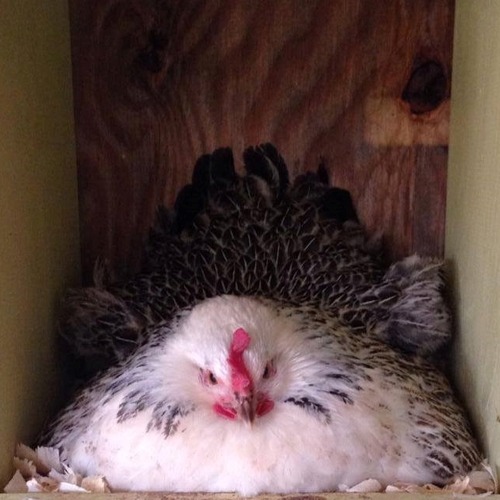
once you’ve been loudly cussed out by 2.5 lbs of feathers, that word only ever means one thing

This is the kinda brooding i WANNA see

#so this behavior basically translates to nonstop cuddling of offspring and vocal aggression towards anything that tries to prevent that #tbh i would be delighted to see male protagonists do just this sort of thing (via starfoozle)

I just had to explain what I was cackling at to my roommate. It automatically passes the Laugh Rule.

She found her reluctant fiance, Erstad, brooding out on the rainy moors. 

“Is that a baby rabbit?” she asked, observing his huddled form. 

“IT’S SIX BABY RABBITS AND YOU CAN’T TOUCH THEM,” replied Ernstad, contriving to look twice his usual size and at least three times his usual fierceness. 

“Whoah okay damn,” she said, and backed away. 

both of these terms accurately describe Batman