Rather than embody the rank pungency of both raw durian and
fermentation microbes, fermented durian diverges from the sum of its
parts. Locals in Malaysia and parts of Indonesia cook with this
yellowish paste, known as tempoyak, to preserve and make use of
non-optimal durians after the end of picking season. Preparation is
simple: Cooks mix about one cup of fruit with one tablespoon of salt to
product a creamy, sour paste that lacks much of durian’s infamous aroma.
Tasters liken the finished product to tangy mayonnaise with a
distinctly acidic profile. It’s not eaten alone, but enhances a breadth
of traditional fare. In Sarawak, chefs ferment durian to pair with meat,
fish, or local petai beans. The lattermost, also called “stink beans”
(due to their aroma and biological effects when consumed) up the ante
when served with a topping of tempoyak and chili-fried anchovies. In
case processing renders the condiment too accessible, this spicy, fishy,
pungent pairing brings a sense of adventure back to eating durian.
Not to sound like a euphoric redditor, but a massive and extremely influential part of American Christianity is just an apocalyptic death cult born out of a need to justify genocide and slavery
see the euphoric redditors wouldn’t bring up the genocide and slavery because they still want to justify those
The next two Avatars, from water and earth, live without ever knowing who they are.
Zuko still spoke out at the meeting, he still refused to fight his father in the Agni Kai.
Zuko was banished, and in his search to find the Avatar, earth bends.
He is the Avatar and doesn’t know what to do about it.
Okay but consider:
Zuko, punching the air: “I MUST FIND THE AVATAR!”
*rock goes flying*
Zuko, waving his arms for emphasis: “IT IS THE ONLY WAY”
*strong wind knocks over grunt in the background*
Zuko, stomping dramatically: “TO RESTORE MY HONOR!”
*deck behind zuko becomes covered in ice*
Iroh, stroking his beard: “…. hmmmmmm…”
And Iroh just decides to mess with him and just goes “Well, I suppose we should start searching” and Zuko doesn’t find out until later in the episode
Nah man, gimme a whole season of Zuko and Iroh’s hijinks as they search for the avatar and it’s Zuko the whole time. A whole season of Iroh waffling between goofy uncle and “here let me teach you about balance-” “I DON”T NEED BALANCE I NEED TO RESTORE MY HONOUR” “okay cool you do you kid i bet the avatar’s behind that rock please move it for me”
zuko saying he needs to find the avatar, when actually, he just needs to find himself is his original story arc
Ah, but you’re not thinking the two of them got exiled on their own from the Fire Nation, did you?
Prince Iroh and exiled Prince Zuko left with a contingent of sailors and military men. Said military personnel realize what is happening three days into their trip.
When wacky spirit shenanigans happen and Zuko solves it without knowing, the military lieutenant look at the commander like he’s in the office.
When Admiral Zhao takes Zuko’s ship and all his crew, and questions them, all of the crew say the same thing:
“No, Prince Zuko hasn’t found the Avatar yet.”
They say this with varying ability to keep a straight face. There’s one of them who just breaks down in helpless giggles.
“Nope,” he gets out between the giggles. “Not found. Definitely not found.”
Admiral Zhao’s men come to the conclusion that Zuko’s crew have cracked under the stress of being away from the Fire Nation so long, and especially on a mission that pretty much the whole Nation “knows” is impossible.
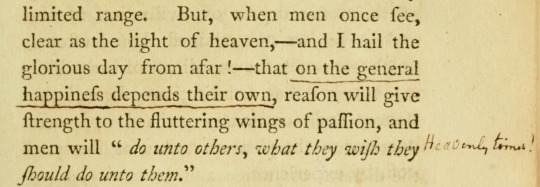
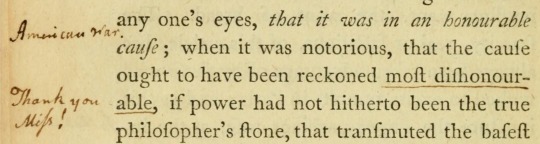
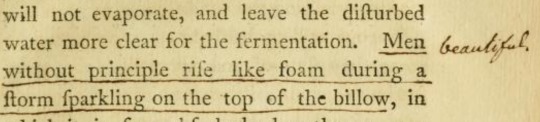
I’m reading John Adam’s annotated copy of Mary Wollstonecraft’s
Historical and Moral View of the French Revolution, ya know, for like, fun. And it’s hilarious. I swear he’s almost a caricature of himself. It’s TOO John Adams™
Like this over-dramatic nonsense
At first, it’s clear he can’t get over the fact that a chick is writing about POLITICS
He loves to write little sarcastic comments when the language and/or sentiments are Too Optimistic for him
also when Wollstonecraft sly-digs the american revolution
He didn’t think Marie Antoinette was All That (later he says “her beauty was chiefly the fiction of flattery”)
Is a total prude even in his most private thoughts #repressed
But every once in a while shows genuine appreciation for good writing
Can we all talk about Marie Antoinette got roasted in that 5th one? 😂
hey I don’t think I’ve ever talked here about corn wolves. here let me find a gas station real quick
okay so I’m in the middle of nowhere stopped for gas in a small town in Iowa rn and my Internet is REALLY spotty so I hope this posts but
as people who have followed this blog for longer might know, sometimes I go hang out with this corn genetics lab at school, as in we meet up on friday nights to talk about corn science and stuff. once the corn genetics subject of the week is covered sometimes we go off track and start talking about other stuff. as u may imagine from a corn genetics lab, most of the members grew up on farms here in the midwest, and one night we were talking and a couple of the people started discussing an urban legend that they were taught as kids to keep them from running into their family’s cornfields and getting lost. one of those people was from Nebraska, and the other from rural minnisoda- these were isolated incidents of this urban legend happening, and all of us were deeply engrossed in this. i cannot make this shit up, this is the story:
there are wolves that live inside the corn when it’s full grown. they’re huge, and are camouflaged to hide in the fields. their breathing sounds like the misting of the irrigation systems set up over the corn in these areas for water. if they see small children in the fields, they kill and eat them.
now I’ve lived my whole life in suburban Iowa, and I can vouch that we don’t have irrigation systems like that here; our group came to the conclusion that this must be the reason that from our 7 or 8 person sample size, the corn wolves did not exist in Iowa, the largest producer of corn. I’ve never seen the corn wolves mentioned anywhere else outside that one night with the genetics lab, and it really fascinates me because as a horror/creepypasta person myself, I think it’s a great example of those strange little urban legends that never get written down on paper. the fact that it’s never appeared anywhere else in my life kind of confounds me, because it’s a really cool story. i like to go driving around rural Iowa when I’m home from college, and i always end up thinking about the corn wolves.
neither of the people believed it as kids btw lol
This is a FANTASTIC piece of Americana and cryptic lore. I propose making them a thing immediately.
Fun geography time.
This isn’t an unprecedented or unusual piece of folklore, and I think
there’s a notable demographic reason that this lore shows-up in the
long-grass prairies of the northern Corn Belt of the U.S. This appears
to be a classic telling of “Roggenwolf” folklore, a variation on the
“feldgeister” concept.
Roggenwolf – or sometimes, Kornwolf – specifically refers to the German folk belief in a phantom wolf spirit which hides in tall corn fields and stalks children. Roggenwolf is one of the more popular and widely-known of the feldgeister spirits.
In German folk culture, Feldgeisters, as is probably obvious from the name, are malevolent spirits which dwell in crops and rural agricultural fields. Feldgeisters
are almost always specifically associated with children; that is, they
are said to target children for torment and death. They are not really
associated with naturally-occurring grasslands or woodlands, but instead
are distinctly related to domesticated crops. Sometimes, some rural
residents will make small ritualistic offerings during harvest season as
a gesture to appease the spirit. The spirit is said to be most active
when crops are at their tallest.
Other variations of the crop-dwelling feldgeister include an evil pig (Roggensau); a dog that tickles children to death (Kiddelhunde); a witch-like corn-woman who kidnaps children (Roggenmuhme); and a chicken that pecks-out children’s eyes (Getreidehahn).
I
would say that there are two (2!) very good reasons why feldgeister lore shows-up in some micro-regions of the Midwest, while being absent
in others. Specifically, both the ethnic heritage and the ecology of a
certain part of the Plains/Midwest create good conditions for
replicating this European lore in North America
People familiar with the cultural
geography of the American Midwest are probably well-aware of the strong
ethnic Norwegian presence among rural agricultural cultures in the
glaciated plains of the Red River Valley of western Minnesota, the
northern half of North Dakota, and northeastern Montana. Ecologically,
this landscape is glaciated prairies with pothole lakes, and often hosts
much more barley than corn. Meanwhile, the Heartland region of rural
Illinois and Indiana, though hosting quite a bit of heavy corn industry,
isn’t too much more ethnically German than other parts of America, and
much of the landscape is a mixture of Rust Belt industrial areas
in-between the cornfields (so it’s not exactly desolate and creepy).
However,
there is very strong ethnic German presence in the long-grass prairies
southern Minnesota, South Dakota, south-central North Dakota, parts of
western Wisconsin, and central Nebraska and Kansas away from the urban
areas of Omaha and Kansas City. In most of this land, over 50% of the
population has German ancestry. Aside from this cultural composition,
this region also lends itself better to creepy, eerie stories because it
is more empty and ecologically homogenous than the rest of the Great
Lakes and Heartlands; this is the region where crops run uninterrupted
for miles and rural dirt-roads run in empty grid networks in every
direction. Though the feldgeister concept has a closer association with
cornfields in Europe, the long-grass prairies (roughly centered neared
Sioux Falls) host 1) heavy German influence, and 2) the most expansive
crops in the country. Therefore, the region is probably ripe for a
replication of spooky German lore about haunted cornfields.
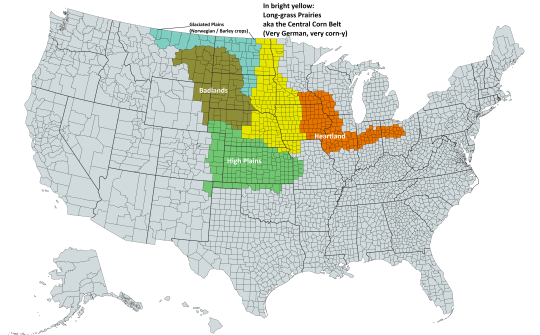
Source: Me Map 1 – Cultural Micro-Regions of the Heartland and Great Plains:
I think that this map might help to visualize where both cornfields and
rural lifestyle predominate, opening the door to rural folklore. The two
regions here where corn agriculture is predominant are the orange and
yellow regions. The orange region, the classic “Heartland”, hosts
Indiana Hoosier culture and the cornfields of Illinois and Ohio.
However, the region is marked by smaller farms and a higher population
density, and is not that rural compared to the plains further west; much
of this region also hosts larger cities and a lot of Rust Belt
industrial zones and dairy farms. The yellow region, however, is both
covered in corn and quite rural, where crops can span from horizon to
horizon. That’s where we would look for German folk culture.
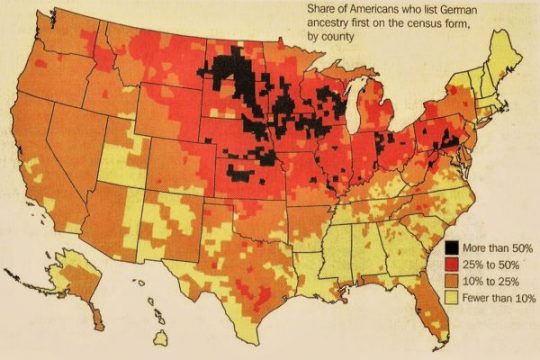
Source: An anonymous hero cartographer who’s had their work stolen by Pinterest users Map 2 – German Ancestry in the U.S.
This might help to visualize the places where predominant corn agriculture overlaps with German ancestry. Note that in much of central Wisconsin and central North Dakota, over 50% of people have German ancestry. But this land isn’t really dominated by corn. However, the region roughly from Fargo (on the Minnesota-North Dakota border) to Kansas City is both heavily German and dominated by corn. —
Anyway, feldgeister lore is scary. I’d love to hear more American versions, since a lot of the scholarship on these spooky corn-wolves is based on folk culture in Germany itself, rather than the diaspora in the U.S.
Saw this post about feldgeister’s going around again, so thought I’d make a low-effort re-post for anyone interested in “Midwestern gothic” or how local ecology influences regional folklore.
this an awesome hot take thank you!!
and just in time for halloween and the corn harvest, too 👀
New Concept: We take live action movies and turn them animated — allowing for more art styles, more animation jobs, a way to break through the misconception that animation is for kids, we all get more cartoons, and ultimately replace the unwanted ‘animation-to-live-action’ genre
Listen I’d give my left armpit for animated remakes of rubber suit monster movies, costume epics, historical dramas and every other live-action movie with an ambitious visual scheme that they maybe couldn’t quite pull off with the effects technology or the budget available to them.









 DarkestElemental616