hey I don’t think I’ve ever talked here about corn wolves. here let me find a gas station real quick
okay so I’m in the middle of nowhere stopped for gas in a small town in Iowa rn and my Internet is REALLY spotty so I hope this posts but
as people who have followed this blog for longer might know, sometimes I go hang out with this corn genetics lab at school, as in we meet up on friday nights to talk about corn science and stuff. once the corn genetics subject of the week is covered sometimes we go off track and start talking about other stuff. as u may imagine from a corn genetics lab, most of the members grew up on farms here in the midwest, and one night we were talking and a couple of the people started discussing an urban legend that they were taught as kids to keep them from running into their family’s cornfields and getting lost. one of those people was from Nebraska, and the other from rural minnisoda- these were isolated incidents of this urban legend happening, and all of us were deeply engrossed in this. i cannot make this shit up, this is the story:
there are wolves that live inside the corn when it’s full grown. they’re huge, and are camouflaged to hide in the fields. their breathing sounds like the misting of the irrigation systems set up over the corn in these areas for water. if they see small children in the fields, they kill and eat them.
now I’ve lived my whole life in suburban Iowa, and I can vouch that we don’t have irrigation systems like that here; our group came to the conclusion that this must be the reason that from our 7 or 8 person sample size, the corn wolves did not exist in Iowa, the largest producer of corn. I’ve never seen the corn wolves mentioned anywhere else outside that one night with the genetics lab, and it really fascinates me because as a horror/creepypasta person myself, I think it’s a great example of those strange little urban legends that never get written down on paper. the fact that it’s never appeared anywhere else in my life kind of confounds me, because it’s a really cool story. i like to go driving around rural Iowa when I’m home from college, and i always end up thinking about the corn wolves.
neither of the people believed it as kids btw lol
This is a FANTASTIC piece of Americana and cryptic lore. I propose making them a thing immediately.
Fun geography time.
This isn’t an unprecedented or unusual piece of folklore, and I think
there’s a notable demographic reason that this lore shows-up in the
long-grass prairies of the northern Corn Belt of the U.S. This appears
to be a classic telling of “Roggenwolf” folklore, a variation on the
“feldgeister” concept.
Roggenwolf – or sometimes, Kornwolf – specifically refers to the German folk belief in a phantom wolf spirit which hides in tall corn fields and stalks children. Roggenwolf is one of the more popular and widely-known of the feldgeister spirits.
In German folk culture, Feldgeisters, as is probably obvious from the name, are malevolent spirits which dwell in crops and rural agricultural fields. Feldgeisters
are almost always specifically associated with children; that is, they
are said to target children for torment and death. They are not really
associated with naturally-occurring grasslands or woodlands, but instead
are distinctly related to domesticated crops. Sometimes, some rural
residents will make small ritualistic offerings during harvest season as
a gesture to appease the spirit. The spirit is said to be most active
when crops are at their tallest.
Other variations of the crop-dwelling feldgeister include an evil pig (Roggensau); a dog that tickles children to death (Kiddelhunde); a witch-like corn-woman who kidnaps children (Roggenmuhme); and a chicken that pecks-out children’s eyes (Getreidehahn).
I
would say that there are two (2!) very good reasons why feldgeister lore shows-up in some micro-regions of the Midwest, while being absent
in others. Specifically, both the ethnic heritage and the ecology of a
certain part of the Plains/Midwest create good conditions for
replicating this European lore in North America
People familiar with the cultural
geography of the American Midwest are probably well-aware of the strong
ethnic Norwegian presence among rural agricultural cultures in the
glaciated plains of the Red River Valley of western Minnesota, the
northern half of North Dakota, and northeastern Montana. Ecologically,
this landscape is glaciated prairies with pothole lakes, and often hosts
much more barley than corn. Meanwhile, the Heartland region of rural
Illinois and Indiana, though hosting quite a bit of heavy corn industry,
isn’t too much more ethnically German than other parts of America, and
much of the landscape is a mixture of Rust Belt industrial areas
in-between the cornfields (so it’s not exactly desolate and creepy).
However,
there is very strong ethnic German presence in the long-grass prairies
southern Minnesota, South Dakota, south-central North Dakota, parts of
western Wisconsin, and central Nebraska and Kansas away from the urban
areas of Omaha and Kansas City. In most of this land, over 50% of the
population has German ancestry. Aside from this cultural composition,
this region also lends itself better to creepy, eerie stories because it
is more empty and ecologically homogenous than the rest of the Great
Lakes and Heartlands; this is the region where crops run uninterrupted
for miles and rural dirt-roads run in empty grid networks in every
direction. Though the feldgeister concept has a closer association with
cornfields in Europe, the long-grass prairies (roughly centered neared
Sioux Falls) host 1) heavy German influence, and 2) the most expansive
crops in the country. Therefore, the region is probably ripe for a
replication of spooky German lore about haunted cornfields.
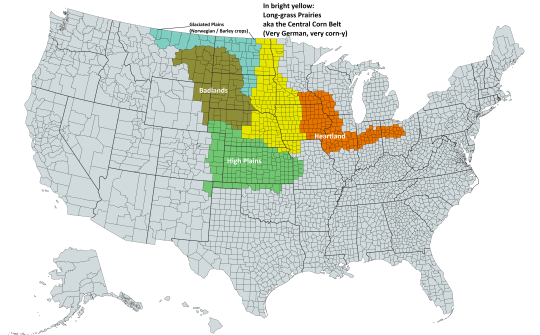
Source: Me Map 1 – Cultural Micro-Regions of the Heartland and Great Plains:
I think that this map might help to visualize where both cornfields and
rural lifestyle predominate, opening the door to rural folklore. The two
regions here where corn agriculture is predominant are the orange and
yellow regions. The orange region, the classic “Heartland”, hosts
Indiana Hoosier culture and the cornfields of Illinois and Ohio.
However, the region is marked by smaller farms and a higher population
density, and is not that rural compared to the plains further west; much
of this region also hosts larger cities and a lot of Rust Belt
industrial zones and dairy farms. The yellow region, however, is both
covered in corn and quite rural, where crops can span from horizon to
horizon. That’s where we would look for German folk culture.
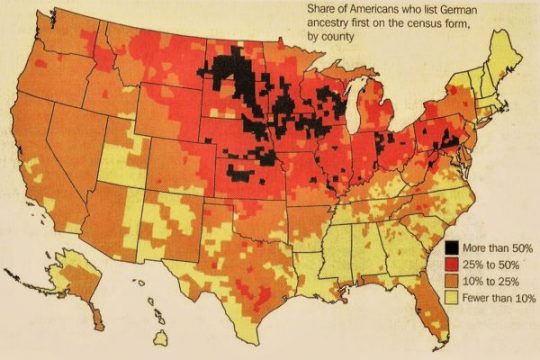
Source: An anonymous hero cartographer who’s had their work stolen by Pinterest users Map 2 – German Ancestry in the U.S.
This might help to visualize the places where predominant corn agriculture overlaps with German ancestry. Note that in much of central Wisconsin and central North Dakota, over 50% of people have German ancestry. But this land isn’t really dominated by corn. However, the region roughly from Fargo (on the Minnesota-North Dakota border) to Kansas City is both heavily German and dominated by corn. —
Anyway, feldgeister lore is scary. I’d love to hear more American versions, since a lot of the scholarship on these spooky corn-wolves is based on folk culture in Germany itself, rather than the diaspora in the U.S.
Saw this post about feldgeister’s going around again, so thought I’d make a low-effort re-post for anyone interested in “Midwestern gothic” or how local ecology influences regional folklore.
this an awesome hot take thank you!!
and just in time for halloween and the corn harvest, too 👀
I love it when Icelandic sagas attribute every microscopic inconvenience that befalls a hero on his journeys to “witchcraft”. It makes me picture a really bored witch just micromanaging the hell out of this one particular guy’s daily travails.
My favorite bit of Icelandic saga is when one dude’s house is invaded by not one, but two bands of zombies (because he pissed off a witch, obviously), which did such terrible zombie things as taking the best spots by the fire and throwing clods of dirt at each other.
The homeowner, being a fine upstanding Icelandic farmer/warrior type, did what you’d expect a Viking warrior to do when faced with invading zombies.
He sued them. In court. With lawyers. As one does.
Norse mythology fails to convey the sense of terror that must have hung over Asgard every time Loki was gone for longer than eight months and three weeks
Also you know that Loki regularly just…brings back random baby animals. That he found in the woods. Claims he gave birth to them. And people believe him every time.
What this means is, that ever single one of the following
Jack Be Nimble (who jumped over burning candles for fun)
Jack the Giant Killer (who sold his cows for magic beans then robbed and killed a giant)
Stingy Jack (who tricked the devil so many times he was banned from both afterlives)
Jack of Jack and Jill (who splattered his head open falling down a hill)
Jack o’ Lantern (the headless horseman spirit of halloween)
Jack Frost (the spirit who heralds the end of autumn and the start of winter)
Are literally the same jackass who made so many bad life choices he ended up an immortal ice dullahan with a pumpkin serving as both his head and flashlight
but what an incredible journey he had getting there
My advise: if you see a suspicious woman washing laundry at a river, don’t talk to her, just walk on. Or talk to her, I’m not your mom. But be warned, she will foretell death. Yours or someone else’s, but death is most assured.
I feel like Banshees are misunderstood tbh, like they’re not causing death nor trying to make you scared; the only thing they’re doing is being like “hey! X person is gonna die soon, you might wanna say goodbye or fix your stuff with them” but like, that’s just my opinion
I was specifically referring to the Washer Woman at the Ford, which, admittedly, is a type of banshee. Personally, I’d suggest a stealthy approach to talking to her, if you happen upon her. You might even get three wishes—-though this requires you to catch hold of her.
On a different note—-I agree that banshees are misunderstood. Media depictions are almost assuredly responsible for this. They’re not the scary monsters they’re made out as, since yeah, they’re only warning you of the death and not bringing it about themselves.
also Scottish Banshees: there were at least one per clan, and they foretold the deaths of members of the clan (usually members of the royal family)…which is awesome, because it was more of a ‘heyyy just a heads up, when this guy rides unto battle, he’s gonna die.’ They looked out for the members of the clan and were seen as important. They weren‘t avoided like the plague
The woman washing clothes in the river sounds like a Red Cap, a fae from Scotland and Ireland that uses the blood of her victims to dye her clothes
I want to point this out before anything else—-I am not trying to disprove you. Rather, I just haven’t come across this particular story/stories. I LOVE learning about different version of myths, legends and folklore!!!!
That being said—-I haven’t heard of a Red Cap in relation to the Washerwoman at the Ford, but I have heard of a Redcap before. Specifically:
Redcaps as a type of goblin-like creature, and live in ruins—-specifically along the border between England and Scotland. They’re called Redcaps because they dye their hats with the blood of their victims. They’re depicted as solely male, unlike the Washer at the Ford, who is a bean sith and therefore a woman. If their cap ever dries out, they die, since they need a continual supply of blood. There is a version where they’re benevolent, but it’s not a particularly widespread version.
What happens if you just quietly help her with her laundry, because hand-washing laundry by yourself sucks?
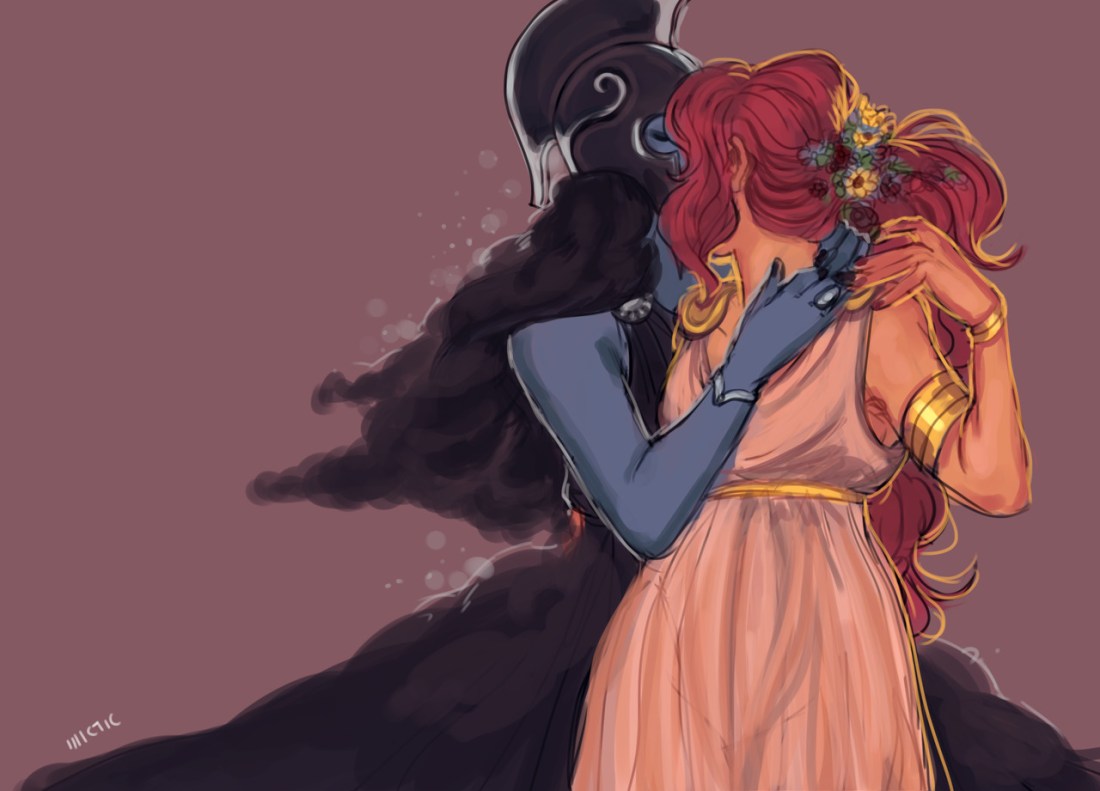
The dryad awoke with the sun, yawning in the pale light. She stretched then got out of bed with an easy grace.
The mermaid slept on, muttering in her native language, complaining about the early hour. She returned to the sleepy seas after her sylvan wife gently kissed her forehead.
Creeping into the kitchen and whistling bird songs, the dryad began the day’s most important task: making coffee.
She slid a trowel’s worth of silt into one side of the machine and a handful of coral into the other. Breakfast prep came next.
“Good morning, lazy scales,” the dryad teased the mermaid as she finally came into the kitchen. Hair as wild as a storm, tail drifting back and forth, eyes as bleary as a treasure map, the mermaid began to reply but opted instead to simply stick out her tongue and make a silly vrrpt noise.
Giggling, the dryad set the table and laid out their breakfast.
I don’t know who first spelled the name as “Guinevere,” but I’m forever thankful that it’s the form in most common use, because other options include “Guanhumara” “Guennuuar” “Gahunmare” and “Wenneuereia”
thanks to whichever medieval person decided it was time to stop calling the queen by random horse noises


 DarkestElemental616