Soot tags gather after fires in areas with low circulation. They are not, as commonly believed, ash covered spider webs.
oh, well then what the FUCK are they???
They’re made of sticky particles from a polymer or petroleum based fire, like burning carpet, drapes, upholstery, and clothes. Due to a static charge, they chain together and naturally gather near ceiling corners because the rising hot air pushes them into the cool spots by convection.
Because they’re formed by static electricity, they can only be removed with professional chemicals and equipment. Attempting to remove them improperly will only break the chain before all the soot can be captured, leaving the remaining soot to spontaneously reform the webs later. Even worse, trying to wipe or wash them away can firmly adhere the soot to your wall or ceiling, which will permanently stain it.
A natural phenomena that only coincidentally resembles the damned webs of transdimensional ghost spiders.
you leave the transdimensional ghost spiders alone, they’re doing a great job
This is actually really fucking clever, because Newton’s Third Law states that for every action there is an equal and opposite reaction.
[Image description: “My physics prof’s memes are improving every week” over an image of the car salesman meme. The meme is as follows:
my thesis involves this principle! in fluids, viscosity (the thickness/stickiness of the fluid) and inertia (the tendency of something to stay in motion when a force is exerted) are in competition. glycerin is incredibly viscous, so the viscosity beats the inertia and the dye doesn’t shift beyond where it is immediately pushed–so exerting an equal and opposite force on the dye just puts it back to its exactly original position.
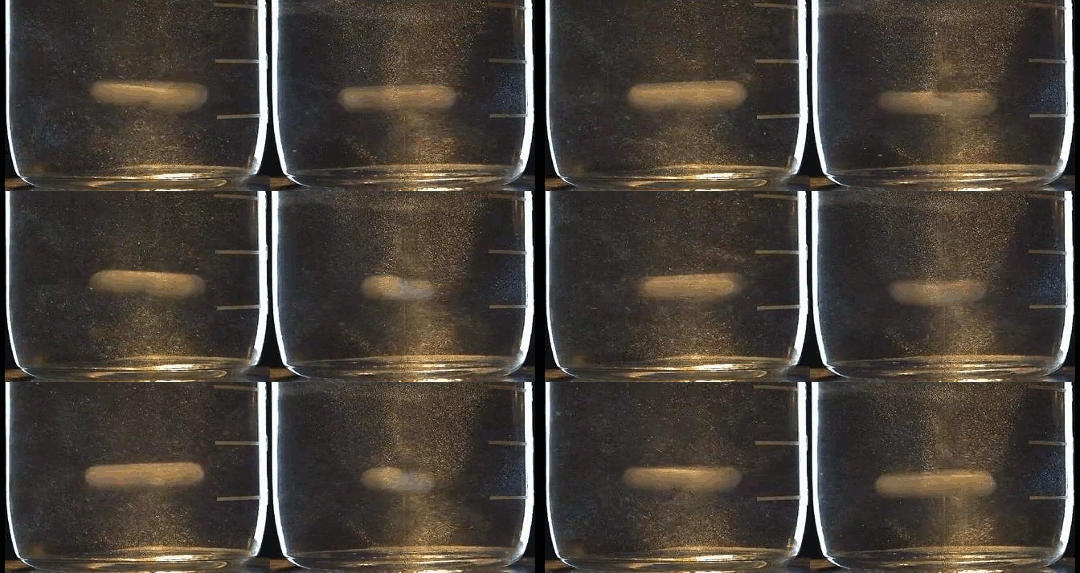
Nearly every lab has a magnetic stirrer for mixing fluids, but this ubiquitous tool still holds some surprises, like its ability to unexpectedly levitate. Magnetic stirrers consist of two main parts, a driving magnet that creates a rotating magnetic field, and a bar magnet – commonly referred to as the flea – that is submerged in the fluid to be stirred. When the driver’s rotating field is active, the flea will spin at the bottom of its container, keeping its magnetic field in sync with the driver.
But if you place the flea in a viscous enough fluid, the drag forces on the flea can pull it out of sync with the driver’s field. Above a certain speed, the flea will jump so that its field repulses the driver’s. That makes the flea levitate as it spins. Depending on the interplay of viscous and magnetic forces, that spin can be unstable (left) or stable (right). The researchers suggest that this peculiar behavior could help artificial swimmers propel themselves or lead to new methods for measuring fluid viscosity. (Image and research credit: K. Baldwin et al.; via APS; submitted by Kam-Yung Soh)
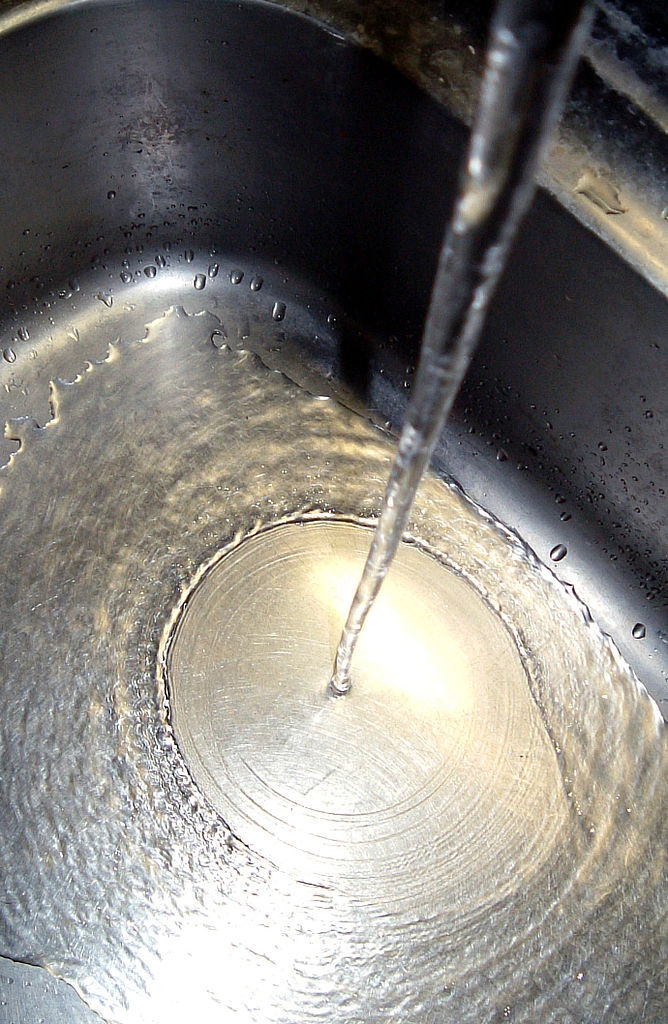
You’ve seen it a million times. When you turn on your kitchen faucet, the falling water forms a distinctive ring – known as a hydraulic jump – in the bottom of your sink. First described by Leonardo da Vinci, this phenomenon has been studied for centuries, and, for nearly all of that time, scientists assumed that gravity played a major role, even in kitchen-sink-sized hydraulic jumps. But that’s not the case.
A newly published study shows that gravity can’t be a major player in setting the radius of these small-scale hydraulic jumps because they form the same whether the jet impinges from above, below, or sideways. Instead, the researchers found that surface tension and viscosity are the parameters that determine the jump’s formation. It’s not every day that you get to overturn a centuries-old theory in physics! (Image credit: J. Kilfiger; research credit: R. Bhagat et al.; via Silicon Republic; submitted by Patrick D.)



 DarkestElemental616