why do ppl in scifi have such a hard time saying ‘thank you’ to robots. i say thank you to inanimate objects all the time and sure as hell would thank a robot for doing even the bare minimum
I would like to note that the first workable submarine was invented in 1620. They were used, to pretty good effect, during the American Civil War.
Either the HG Wells quote is wrong or he’s just that ignorant.
It has come to my attention as of late that people do not fully understand the difference in the punks. Some people seem to think that Steampunk is pretty much everything when you see it.
Let us review the fundamentals. Steampunk is set in an alternate future where steam was the primary technology and they continued on that path till now. That’s basically it. However there are MANY alternate futures with alternate technology’s, and lumping all of them into steampunk is just cheapening them. So let me just show you an example of each.
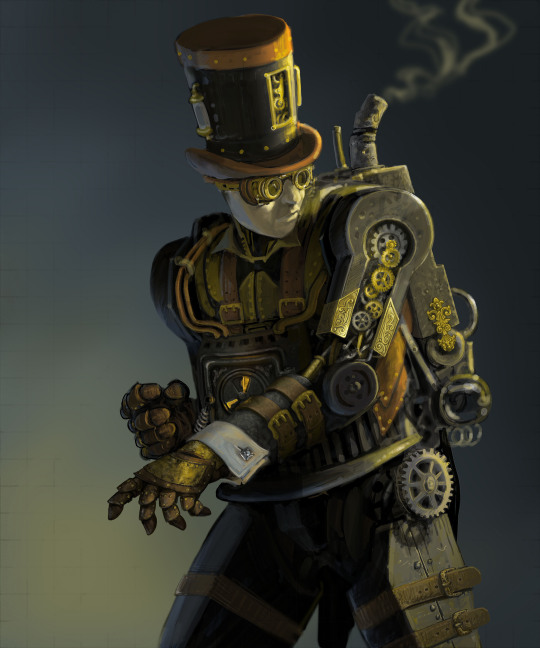
CLOCK/STEAMPUNK: This era is often Victorian in style for some reason and the steam powered robots often use lots of smoke stacks, gears, clockwork, belts and goggles.
TESLAPUNK: Unlike steampunk, this world functions as if Nikola Tesla had revolutionized the world with his electricity. Lots of lightning rods, Tesla rods and power cables. Often this is confused as steampunk because they often have the a similar look.
DIESELPUNK: This universe takes place in a world where diesel engines and machines using oil are everywhere. This is criminally underused. They usually use a more art deco and WW1/2 style.
ATOMIC/RAYPUNK: This one uses atomic technology. Lasers, blasters, radiation, green glows, aliens and giant robots. Also rarely used but I dare you to watch “The Iron Giant” and tell me you don’t love it.
CYBERPUNK: Possibly more well known than steampunk. A future, in which technology is so advanced people are more technologically advanced than some of the robots. Chainsaw arms, robotic eyes, hooking your brain up to the internet and evil corporations.
BIOPUNK: Imagine a future where technology has advanced so much that we construct living organisms as easily as building a robots. Living machines, weapons, organic clothing and new and improved limbs.
JUNKPUNK: Almost as unknown as candlepunk but still one to remember. This world all technology is composed of random parts you might find in a junkyard. Kind of like the ‘Coolest’ cooler.
SOLARPUNK: This one has been getting some recent attention. However in a world where technology is powered by the sun I have yet to find one robot picture so sorry about this one.
PUNKPUNK: You have gone off the far side of the spectrum. Turn back.
Hopefully now you can tell the different alternate futures apart and can better survive in the world with this Essential information.
(Note this is not my artwork just a quick google search, but I am working on a series that will clarify these examples better with my own work.)
Yo, just saying, but Cyberpunk ISN’T just an aesthetic.
Cyberpunk is a genre about contrast between high technologies and low life, and as such they focus on sadder/violent parts of people’s lives, like crime, law enforcement (treated realistically and not like in cop dramas), cybercrime, drug dealing, terrorism or warfare.
Common themes include any variation on a concept of identity (from identity theft, through search for identity, to identity politics), loneliness in digital age, anti-capitalism focusing on unchecked power of corporations, anti-fascism focusing on technological surveillance state, ethics of artificial intelligence and other technologies.
Best known examples are probably Robocop, Ghost in the Shell, Matrix (especially the first movie, sequels are more like post-apo war stories), Neuromancer, Snow Crash, Deus Ex, Shadowrun, System Shock.
Steampunk was an offshoot of cyberpunk, but since stopped being a genre and became only an aesthetic.
Biopunk is offshoot of cyberpunk, and usually contains similar themes (just with genetic engineering). Other offshoots include nanopunk (with nanotechnology) and, which has recently been getting more attention, nowpunk – stories that use concepts and themes of cyberpunk, but are set in contemporary times – we’re talking stuff like Mr Robot tv show, or Watch_Dogs video games.
Honestly, a lot of the punk settings and ideas are in some way political, or at least VERY good at exploring issues relevant to the time period they pull inspiration from.
Steampunk for imperialism, biopunk for ethical issues of biotechnology, atompunk for the red scare and cold war, etc. etc.
Not saying every story with these looks NEEDS to deal with those specific issues, but each punk type opens itself up to discussing those types of issues much more easily.
Also, each punk doesn’t need to exist separate from each other. I have a setting that is bio, solar, and junkpunk all at once.
These genres and aesthetics are tools, and the rules about ‘em aren’t hard and fast to say the least.
The “punk” part of all of these is a political analysis and a rebellion.
Steampunk without addressing the imperialism and class privilege of the Victorian era is “gaslamp fantasy” or “alternative history sci-fi”, depending on how sci-magical it goes.
Cyberpunk without the dystopia of a world ruled by megacorporations, and the small rebellions people engage in just to survive, is just gritty sci-fi.
Dieselpunk that doesn’t analyze how the imperialism of the late 19th century evolved into the rise of fascism in the early 20th is just more alternative history sci-fi.
Teslapunk have some similar imperialism themes to steampunk plus some of the anti-corporate vibe of cyberpunk. It’s an analysis of thing like “what would the world be like if an autistic dreamer like Tesla hadn’t been ground into the dirt by the corporate greed of Edison and others?” or “what if Edison and the other corporatists had stolen EVEN MORE of Tesla’s work?”
Solarpunk seeks to build clean energy, green spaces, and sustainable industries in response to the real threat of climate change.
The “punk” part is important. It gives us tools to dismantle injustice in the real world by analyzing or overcoming the injustice in a fictional one.
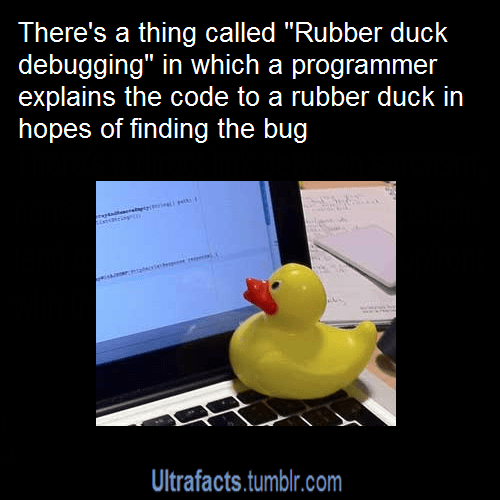
Some of you are reblogging because you think its funny that programmers would talk to ducks. I’m reblogging because I think its funny picturing a programmer explaining their code, realizing what they did when they explain the bad code, then grabbing the strangling the duck while yelling “WHY WAS THE FIX THAT SIMPLE!? AM I GOING BLIND!”
AS A PROGRAMMER I CAN TELL YOU THAT THIS IS EXACTLY WHAT YOU FUCKING DO WE HAD TO BAN THE DUCKS FROM MY CLASSES BECAUSE EVERYONE WOULD FLIP THE DUCK OR THROW IT AT A WALL OR SOMETHING WHEN THEY FIGURED OUT THE PROBLEM IN THEIR CODE
so that’s the function of a rubber duck
^^^^^^^^^^^^^
I work at a startup and part of the onboarding package you get when you first start working here now includes a rubber duck. We also have a bigger version of the duck for the extra hard problems. Sometimes one duck doesn’t cut it and you need to borrow your neighbors to get more ducks on the problem. One time we couldn’t figure out why something wasn’t working right so we assembled the counsel of ducks and by the grace of the Duck Gods were we able to finally come to a solution. These ducks have saved many lives and should be respected for the heroes they are.
I use this for writing, actually. Explain what I’m doing and what I want to do and the different ways i can get to point B from A, as well as the different problems, amazingly working them out as I explain why I could or couldn’t the different things. I love the Rubber Duck theory.
Former programmer, can confirm. We didn’t have a duck in our office so our other programmer, who I shared a space with, used me as a duck proxy. (For the explaining, not the throwing.)
There was more than one day where I’d casually hear “Hey can you be a duck for a minute?”
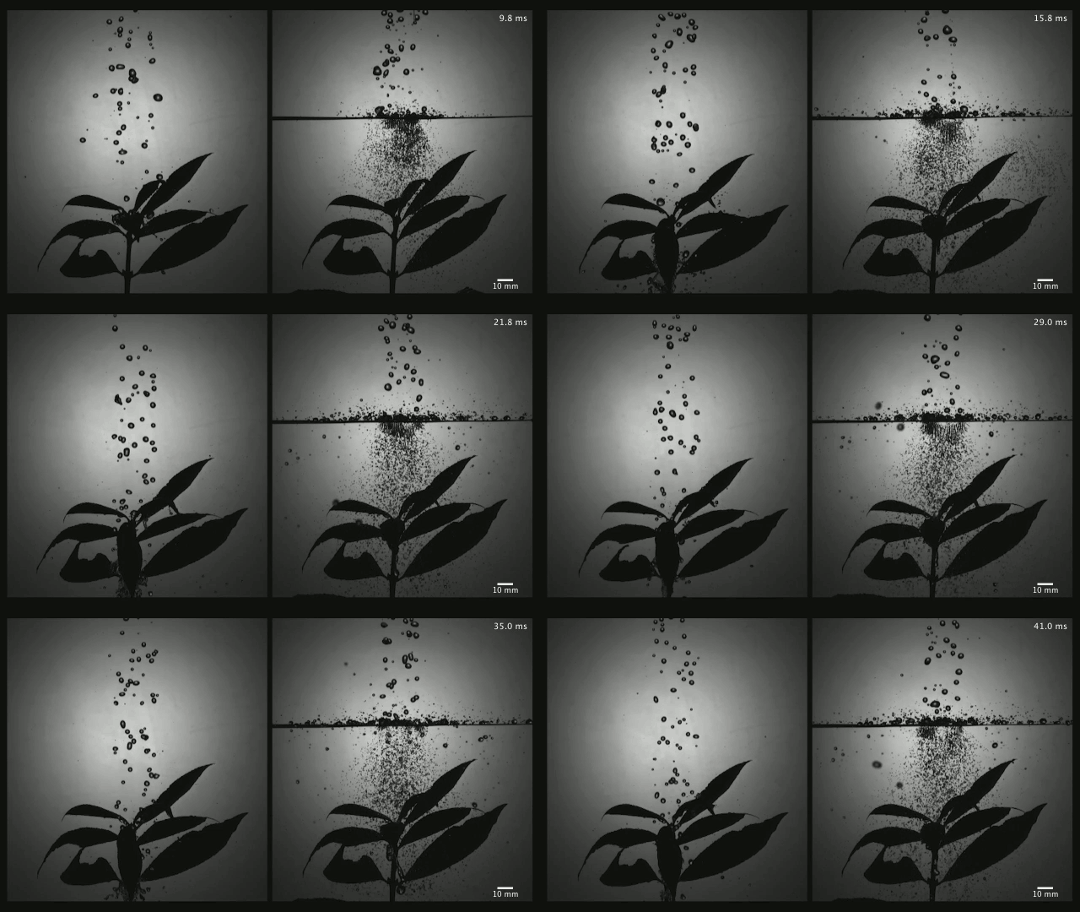
Lots of applications – from rocket engines to ink jet printing – require breaking large droplets into smaller ones, so there are many methods to do this. Some techniques rely on fluid instabilities, others use ultrasonic vibration. But one of the most effective methods may also be the simplest: placing a mesh between large drops and their target.
That’s the idea at the heart of this new study, which uses a wire mesh to break large droplets into a spray of finer ones 1000 times smaller. The target application is agricultural spraying, and the researchers argue that their method would allow farmers to treat their crops effectively with fewer chemicals and less run-off. Drops impacting the mesh form a narrow cone over the plant, and the smaller, slower droplets are better at sticking to the plant instead of bouncing away. They’re also less likely to injure crops, since they don’t disturb the leaves the way larger drops do. (Image and research credit: D. Soto et al.; via MIT News; submitted by Omar M.)
In 1978 Japan’s Ministry of Economy, Trade and Industry established the encoding that would later be known as JIS X 0208, which still serves as an important reference for all Japanese encodings. However, after the JIS standard was released people noticed something strange – several of the added characters had no obvious sources, and nobody could tell what they meant or how they should be pronounced. Nobody was sure where they came from. These are what came to be known as the ghost characters (幽霊文字). […]
By interviewing the catalogers involved in the creation of the standard, the investigators established that some characters were inadvertently invented as mistakes in the cataloging process. For example, 妛 was an error introduced while trying to record “山 over 女”. “山 over 女” occurs in the name of a particular place and was thus suitable for inclusion in the JIS standard, but because they couldn’t print it as one character yet, 山 and 女 were printed separately, cut out, and pasted onto a sheet of paper, and then copied. When reading the copy, the line where the two little pieces of paper met looked like a stroke and was added to the character by mistake. The original character (𡚴) was not added to JIS or Unicode until much later and doesn’t display on most sites for me.
technology related sensory memories from my childhood
sliding the metal cover on floppy disks
the slight resistance of inserting cassette and video tapes
ripping off the strips of holed paper off of dot matrix printer paper
rolling the wheel on a disposable camera to take another photo
The heaviness and rubber texture of the roller ball in a computer mouse, and the little ring of lint
Unkinking the curly cord of a telephone while you talked
The -peww sound and slowly fading image of a crt monitor turning off, and then running your finger through the static on the dusty glass
The crunch of opening or closing a plastic Disney vhs cover
The sound effects in kidpix
Extending and collapsing metal antennas and using them as magic wands
…God, it is so weird these things aren’t around any more. Cause it’s true, the sensations are so distinct. It’s bizarre to think about missing these tiny relics.
almost all popular fiction about robots: given the chance to abuse something without repercussions, humanity would do so without hesitating, because we’re all just lazy, heartless bastards by nature
me, sprinkling cereal grains across the floor so my roomba doesn’t go hungry: who’s a good boy? 😀 who’s a good boy??? 😀 😀 is it YOU???? 😀 😀 😀 it’s YOU!!!!!!!














 DarkestElemental616