Moved here in the wake of the great tumblr nsfw purge of 2018. What's currently here are my archived posts from that blog. Multi-fandom artist and writer. I also have a DeviantArt under the same username.
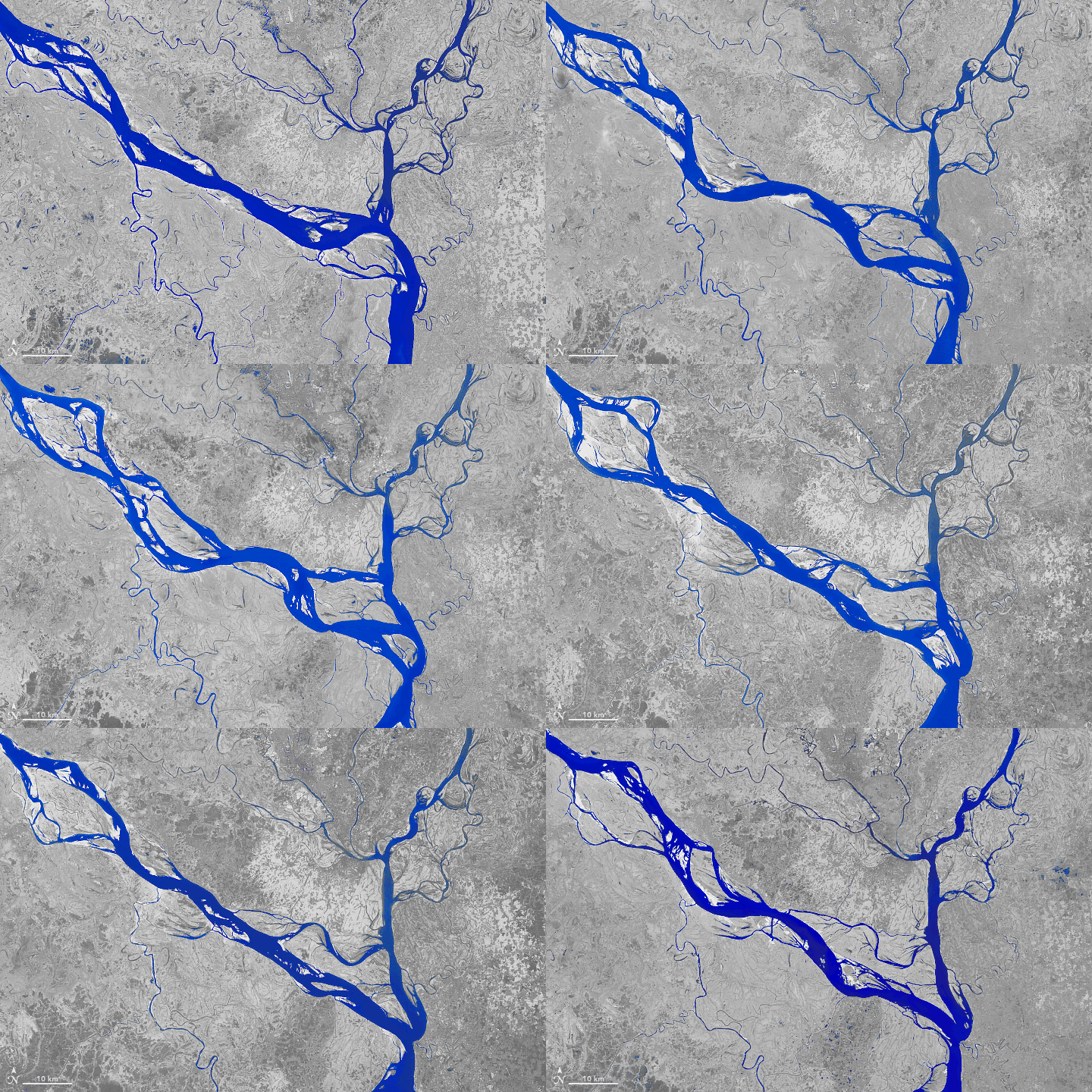
This beautiful gif was prepared using data from the long-lived Landsat series of earth orbiting satellites, You are looking at the course of the Padma River in Bangladesh and how its course has varied over the last 30 years. This is a textbook example of river erosion processes. When rivers begin to meander, they evolve by growing their meanders wider, until the meander finally gets too sinuous and the river finds another path. Pick a point where the river bends and watch what happens – the outer bank of the river erodes and sediment deposits on the inner side of the curve, making the river arc farther outwards. The outer side of the river that is eroding is called a cut bank, and sediment is deposited on the inside of the river building a point bar.
“Unlike Godzilla, Pacific Rim doesn’t try to be serious even when it’s being serious. Characters have names like Stacker Pentecost and Hercules Hansen. The film requires you to believe that the best way to battle a giant monster is to build an even larger robot to fight that monster. Much of the Act 2 drama derives from inter-pilot tension airlifted from the Val Kilmer scenes in Top Gun. It’s the polar opposite of the Godzilla school of drama, where everyone is a total professional who has absolutely no personal goal besides Saving The World. In Pacific Rim, Idris Elba is Rinko Kikuchi’s Obi-Wan Kenobi, and two of the last Giant Robot-pilots in the world frequently get into sneering fights over who’s the bigger badass, and Charlie Day is a scientist. So, for all these reasons, Pacific Rim is a movie that I’ve heard perfectly smart people describe as “stupid” or “silly.” The problem with this line of thinking is that, really, that every blockbuster is pretty “silly,” in the context of Things Adults Should Care About. Godzilla is not less stupid than Pacific Rim just because people frown more. […] The difference, I think, is that Pacific Rim glories in its own silliness. There’s a flashback scene where Idris Elba rescues a little girl, and when he emerges from his giant robot, the sun shines upon him like he’s the catharsis in a biblical epic. There’s a moment when one giant robot swings an oil tanker like a sword. Then it grows a sword out of its wrist. Then it falls from space to earth. There are real complaints to make about Pacific Rim, I guess, all of them fair and most of them pedantic. I know a lot of people who have issues with the story. (“Why didn’t they use the wrist-sword earlier?” is a popular one.) Conversely, I don’t really know anyone who minds the story in Godzilla, possibly because everything stupid that happens is prefaced by Frowning Watanabe saying “This is why the stupid thing that’s about to happen makes sense.” Godzilla wants so badly to make sense. Pacific Rim wants so badly for Ron Perlman to wear golden shoes.”
— Darren Franich, “Entertainment Geekly: A call for an end to serious blockbusters” (via rahleighs)
People talk a lot about Sam’s lack of autonomy in his own
life, but it’s also interesting how often that correlates to the times
he’s literally been sold, bought, or otherwise leveraged as currency.
Off the top of my head:
– Mary’s deal with Azazel- trading
not-yet-alive-Sam’s blood and future for John’s life
– Dean’s demon deal- trading his own soul to
obtain Sam’s soul and life.
– Michael reviving Sam from Anna’s attack- Dean
demands that Michael ‘fix Sam’ which he agrees to do after they talk. He says
that Dean is not his only true vessel (in the same ep that Anna says Sam is
Lucifer’s only true vessel) and that they are destined to say ‘yes.’ He brings
Sam back from the dead in preparation for that final fight, for Lucifer.
– Dean’s deal with Death in season 6×11- trading a
service of serving as Death (and the amusement that provides) for Sam’s soul
and the service of Death putting it back in.
– Cas breaking Sam’s wall- to keep Dean occupied.
He says that he will ‘save Sam, but only if Dean stands down’- he uses Sam’s
sanity as an object for the service of Dean not attacking.
– Gadreel possessing Sam- when he was still
‘Ezekiel,’ he wanted a vessel to stay in to recuperate (service). In return, he
said that he would heal Sam’s body from the inside (service).
–
there’s the obvious 13×11 where he is actually auctioned
off.
– Lucifer bringing Sam back- to give as a gift/sign
of goodwill (object) to get closer to Jack.
The imagery associated with the above examples is also
interesting. In every example, he is
laying down- in all except for the baby one, it is because he is in a position
of no power: either too sick to move, dead, or tied down while others negotiate
over his prone body.
There’s many more times when his autonomy is taken away. But
this on-going pattern of his body/soul being traded without his consent implies ownership to a disturbing
degree. Normally that power is vested in Dean, but it’s also commonly co-opted
by Lucifer.
It’s also interesting that whenever Sam tries to trade for
own his body/mind/soul, it is refused. None of the demons would trade with him
to save Dean, when Soulless Sam still wanted the soul no one would work with
him, trading his body for the trials ultimately fails, Cas won’t extract all of
Gadreel’s grace from Sam’s body because he values life more, offering his soul
to Casifer doesn’t do anything, offering to take the burden of the mark doesn’t
do anything. When he casts Lucifer into the cage, the ‘trade’ is accepted- but
this is a plan sanctioned by the ‘good guys.’ Whenever Sam attempts to leverage
himself without the explicit permission of Dean, he fails.
Any self-initiated exchange fails, but when he is traded by other people? When he is the passive
object to be negotiated over? Those measures all succeed. It’s just another
marker of the lack of control he has in his own life. And by repeating this
pattern, the narrative perpetrates the idea that Sam does not have ownership of
himself, either.









 DarkestElemental616